Walk into any fast-moving restaurant today, and something feels different.
The counter isn’t crowded anymore.
Orders are moving faster.
Customers are not waiting, they’re interacting.
This shift is not accidental.
It’s driven by one system that’s quietly transforming restaurant operations:
a self ordering kiosk for restaurants
But here’s what most restaurant owners actually want to know:
What really changes when you install a self ordering kiosk for restaurants?
What is a Self Ordering Kiosk for Restaurants?
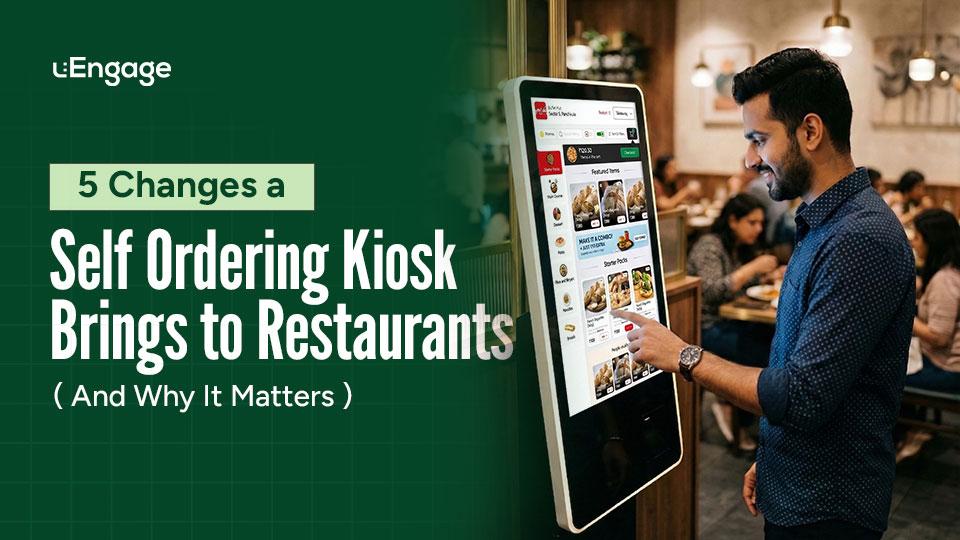
A self ordering kiosk for restaurants is a digital touchscreen system that allows customers to browse the menu, place orders, customize items, and complete payments without staff interaction.
Unlike traditional ordering, it connects directly with:
-
kitchen workflows
-
payment gateways
-
customer data systems
In simple terms, it turns ordering into a self-service, system-driven experience.
How Does a Self Ordering Kiosk Work in Real Restaurant Operations?
Here’s how a self ordering kiosk for restaurants works in real time:
-
Customer walks in and uses the kiosk
-
Selects items and customizes the order
-
Makes payment directly
-
Order is instantly sent to kitchen
-
Customer waits for pickup
Behind this simple experience:
-
orders sync with POS
-
data flows into CRM
-
operations become faster and more structured
This is not just a screen. It’s an operational layer.
Why Restaurants Are Rapidly Adopting Kiosk Ordering Systems
The shift toward self ordering kiosk for restaurants is backed by data:
According to industry studies:
-
Restaurants using kiosks see up to 30% faster ordering times
-
Average order value increases by 15–25%
-
Order accuracy improves significantly, reducing refunds
As one QSR operator puts it:
“The kiosk didn’t just reduce queues, it changed how customers interacted with our menu.”
This is why kiosk ordering systems for restaurants are no longer optional in high-volume setups.
The 5 Real Changes a Self Ordering Kiosk Brings to Restaurants
1. Ordering Speed Becomes Independent of Staff
In traditional setups:
-
one staff = one order
-
queues slow down flow
With a self ordering kiosk for restaurants:
-
multiple customers can order simultaneously
-
peak-hour bottlenecks reduce
Impact: Faster throughput without increasing staff.
2. Average Order Value Increases Automatically
Kiosks consistently:
-
suggest add-ons
-
promote combos
-
highlight upgrades
Customers feel more comfortable exploring.
Research shows digital ordering systems can increase order value by up to 25%.
Impact: Higher revenue without additional marketing spend.
3. Order Accuracy Improves Dramatically
Manual errors include:
-
wrong items
-
missed customisations
-
communication gaps
A self ordering kiosk for restaurants removes this by:
-
capturing exact customer input
-
syncing directly with kitchen
Impact: Fewer complaints, better customer satisfaction.
4. Staff Productivity Improves (Not Reduces)
A common myth:
kiosks replace staff
Reality:
kiosks reassign staff
Staff now focuses on:
-
service quality
-
customer assistance
-
operations
Industry insight:
“The goal isn’t fewer people, it’s smarter allocation of people.”
Impact: Better experience efficient team usage.
5. Your Restaurant Moves from Manual to System-Driven Operations
This is the biggest shift.
A self ordering kiosk for restaurants is not standalone.
It connects with:
-
restaurant online ordering system (Edge)
-
restaurant CRM software (Prism)
Platforms like uEngage bring all of this together.
Impact: Your restaurant starts running on a connected ecosystem, not scattered tools.
Self Ordering Kiosk vs Traditional Counter Ordering
| Factor | Kiosk Ordering | Counter Ordering |
|---|---|---|
| Speed | Multiple orders at once | Limited by staff |
| Accuracy | High | Error-prone |
| Order Value | Higher (upselling) | Limited |
| Experience | Self-paced | Queue-based |
Benefits of Self Ordering Kiosks for Restaurants
A self ordering kiosk for restaurants delivers:
-
faster service
-
higher order value
-
reduced operational errors
-
better customer experience
-
improved data collection
This is why many restaurant automation systems now include kiosks as a core component.
When Should You Use a Self Ordering Kiosk?
A self ordering kiosk for restaurants makes sense when:
-
your restaurant has high footfall
-
queues slow down service
-
staff is overloaded
-
order accuracy issues exist
It’s not about replacing counters.
It’s about removing friction from ordering.
The Bigger Shift: From Counter-Based to System-Based Restaurants
Earlier:
Ordering = manual
Systems = disconnected
Now:
Ordering = digital
Systems = connected
A self ordering kiosk for restaurants is often the first step toward:
-
mobile app ordering
-
QR ordering systems
-
delivery management
-
customer engagement
Final Thought
Customers don’t notice systems.
They notice:
-
speed
-
accuracy
-
ease
But behind that simplicity is a structured system.
A self ordering kiosk for restaurants is not just about automation.
It’s about building a restaurant that can:
-
handle more orders
-
reduce operational chaos
-
improve margins
-
scale efficiently
And in today’s environment, that’s what separates growing restaurants from struggling ones.