A customer orders from your restaurant, enjoys the food and then disappears.
This does not always mean that the customer disliked the experience. They may have forgotten your restaurant, started ordering from another brand or simply did not receive a relevant reason to return.
That is where restaurant remarketing strategies can help.
Restaurant remarketing uses customer data, previous orders and automated communication to reconnect with people who have already interacted with your restaurant. Instead of sending the same discount to every customer, you can deliver timely and relevant messages based on their ordering behaviour.
Quick Answer: How Can Restaurants Bring Back Inactive Customers?
Restaurants can bring back inactive customers by:
Defining inactivity based on the normal ordering cycle
Segmenting customers using recency, frequency and order value
Creating personalised win-back campaigns
Using WhatsApp remarketing strategically
Recovering abandoned carts and incomplete orders
Recommending items based on previous purchases
Using loyalty rewards instead of excessive discounts
Creating new reasons for customers to return
Measuring incremental orders and continuously optimising campaigns
The most effective restaurant customer re-engagement strategy combines customer segmentation, personalised communication, marketing automation and a convenient direct-ordering journey.
What Is Restaurant Remarketing?
Restaurant remarketing is the process of reconnecting with customers who previously ordered, visited a restaurant website, joined a loyalty programme or started an order but have not returned within an expected period.
For example, if a regular customer previously ordered twice every month but has not placed an order for 45 days, the restaurant can identify this change and send a personalised re-engagement message.
Restaurant remarketing may use:
WhatsApp messages
SMS campaigns
Push notifications
Email marketing
Loyalty rewards
Abandoned-cart reminders
Personalised menu recommendations
Limited-time menu announcements
Unlike mass promotions, effective remarketing considers who the customer is, what they previously ordered and when they are most likely to order again.
“Remarketing should remind customers why they liked your restaurant not teach them to wait for another discount.”
Why Restaurant Remarketing Matters
Acquiring a new customer often requires advertising, discovery, trust building and a strong first-order incentive. An existing customer already knows your restaurant, which makes re-engagement an important growth opportunity.
Personalisation also affects whether customers respond to brand communication. According to McKinsey:
71% of consumers expect personalised interactions.
76% become frustrated when personalisation is missing.
78% say personalised content makes them more likely to repurchase.
For restaurants, this means a message such as “Order your usual paneer tikka meal tonight” can be more relevant than a generic “Get 20% off” campaign sent to the entire database.
Customer loyalty is equally important. The National Restaurant Association reports that more than three-quarters of restaurant customers are more likely to visit a restaurant where they can earn points, even when it is less convenient.
The goal of restaurant retention marketing, therefore, is not simply to send more messages. It is to create more relevant reasons to return.
When Should a Restaurant Consider a Customer Inactive?
There is no universal inactivity period for every restaurant.
A café customer may normally order every week, while a fine-dining customer may visit only once every few months. Restaurants should define inactivity according to their typical purchase cycle.
Restaurant type | Starting inactivity window | Why it may work |
|---|---|---|
QSR or cloud kitchen | 21–30 days | Customers may order several times a month |
Café or bakery | 30–45 days | Visits are often habitual but less frequent |
Casual-dining restaurant | 45–90 days | Purchase cycles are usually longer |
Occasion-based bakery | 60–120 days | Orders may depend on birthdays and celebrations |
Fine-dining restaurant | 90–180 days | Longer gaps between visits can be normal |
These are starting points, not fixed rules. A restaurant should study its own customer data before deciding when to launch a win-back campaign.
A better definition is:
An inactive customer is someone who has gone significantly longer than their usual ordering interval without placing another order.
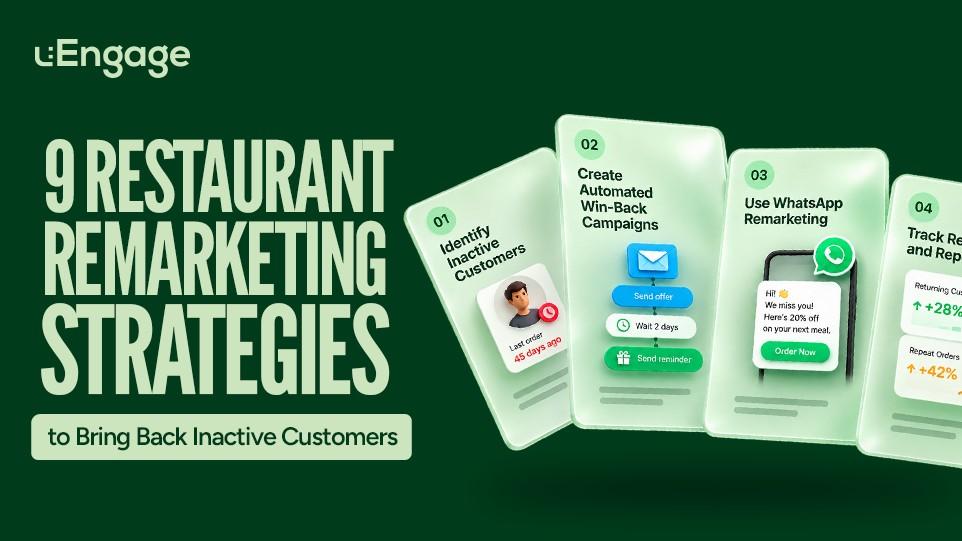
9 Restaurant Remarketing Strategies That Can Bring Customers Back
1. Define Inactivity Using Actual Ordering Behaviour
The first mistake restaurants make is putting every non-ordering customer into one “inactive” group.
Someone who ordered seven days ago is not the same as someone who has been absent for six months. Your restaurant CRM should separate customers according to the time since their last order.
A practical framework could include:
Recently active: ordered within the last 30 days
At risk: no order for 31–60 days
Inactive: no order for 61–90 days
Lapsed: no order for more than 90 days
The exact ranges should reflect your restaurant’s natural ordering frequency.
You should also compare each customer’s present behaviour with their previous pattern. If a customer normally orders every Friday but has missed three consecutive Fridays, they may already be at risk even if they do not meet a standard 60-day rule.
With a restaurant marketing platform such as uEngage Prism, restaurants can use ordering data and customer segments to identify audiences that require attention. This gives marketing teams a clearer starting point than exporting a complete customer list and sending a bulk offer.
2. Segment Customers Using RFM Analysis
Once inactivity has been defined, the next step is customer segmentation.
One useful model is RFM analysis:
Recency: How recently did the customer order?
Frequency: How often did the customer order?
Monetary value: How much did the customer spend?
Consider two customers who have both been inactive for 60 days:
Customer A previously ordered twice a week.
Customer B placed only one small order.
Customer A represents a sudden behavioural change and may deserve a higher-priority campaign. Customer B may need more brand education before becoming a repeat customer.
Restaurants can create segments such as:
Previously frequent customers who recently became inactive
High-value customers who have not returned
One-time customers who never placed a second order
Customers who ordered only during a discount campaign
Customers who frequently purchased a particular category
Loyalty members with unused points
Customers inactive at a specific outlet or location
Using customer segmentation for restaurants helps ensure that each audience receives a message suited to its relationship with the brand.
Example Segmentation Plan
Customer segment | Customer signal | Recommended campaign |
|---|---|---|
One-time customer | No second order within 30 days | Introduce bestsellers and brand benefits |
Previously frequent customer | Ordering frequency suddenly declines | Personalised “We miss you” message |
High-value customer | No order within expected cycle | Early access or exclusive menu experience |
Offer-led customer | Orders only during discounts | Promote bundles, convenience and loyalty value |
Loyalty member | Points remain unused | Points reminder with a direct-ordering link |
Prism can help restaurants build actionable customer segments using order history, frequency, spending and engagement data.
3. Create a Multi-Step Win-Back Campaign
One message is rarely a complete remarketing strategy.
A structured restaurant win-back campaign should gradually create urgency without overwhelming the customer.
Sample Restaurant Win-Back Journey
Day 1: Relevant reminder
Remind the customer about a favourite item, their previous experience or a convenient ordering occasion.
“Your Friday biryani ritual has been quiet lately. Your favourites are ready whenever you are.”
Day 4: Add a reason to return
Introduce a new dish, seasonal menu, meal bundle or improved ordering experience.
“There’s something new on our menu and we think it matches your usual order.”
Day 8: Introduce value
If the customer still does not respond, add a loyalty benefit, free add-on or limited reward.
“You have 120 loyalty points waiting. Use them on your next direct order.”
Day 12: Pause communication
If there is still no response, move the customer into a lower-frequency segment instead of continuing to send reminders.
This sequence protects the customer experience and prevents over-messaging.
With restaurant marketing automation, each step can be triggered according to customer activity. Once the customer orders, they should immediately exit the win-back journey.
“The purpose of automation is not to send more messages. It is to stop sending irrelevant ones.”
4. Use WhatsApp Remarketing Without Spamming Customers
WhatsApp is an important customer communication channel for Indian restaurants, but its effectiveness depends on relevance, permission and timing.
A useful WhatsApp remarketing strategy for restaurants should:
Target a defined customer segment
Refer to a meaningful behaviour or preference
Communicate one clear message
Use one prominent call to action
Link directly to the relevant menu or ordering page
Respect customer consent and opt-out preferences
Avoid sending too many messages
Weak WhatsApp Message
“FLAT 25% OFF! ORDER NOW! LIMITED TIME!”
This message may create short-term clicks, but it offers no personal context and trains customers to expect discounts.
Better WhatsApp Message
“Hi Riya, craving your usual Margherita and garlic bread? They’re just a few taps away. Order directly before 9 PM and collect double loyalty points.”
The second message is more effective because it combines familiarity, convenience and loyalty value.
Prism can help restaurant teams manage segmented WhatsApp, SMS and push-notification campaigns from their customer data instead of communicating with everyone in the same way.
5. Recover Abandoned Carts and Incomplete Orders
Not every inactive customer has completely lost interest. Some customers browse the menu, add items to their cart and leave before completing payment.
Possible reasons include:
Unexpected delivery charges
A complicated checkout process
Payment failure
An unavailable item
Distraction during ordering
Uncertainty about delivery time
Difficulty applying an offer
An automated abandoned-cart message can help recover this existing intent.
Example Cart-Recovery Message
“Your order is still waiting. Complete it in a few taps and we’ll start preparing it right away.”
The message should take the customer directly back to the cart or relevant ordering page, not to the restaurant homepage.
A good cart-recovery sequence may include:
A reminder within 30–60 minutes
A second reminder later that day
A final message only when there is a genuine time-sensitive reason
Restaurants should also investigate the point at which customers leave. Remarketing cannot permanently compensate for a confusing checkout experience.
Prism’s customer journeys and campaign guardrails can support behaviour-based communication, while a smooth direct-ordering experience helps customers complete the transaction.
6. Personalise Messages Using Previous Orders
Customers are more likely to notice a message when it reflects something they genuinely like.
Restaurants can personalise remarketing campaigns using:
Previously ordered dishes
Vegetarian or non-vegetarian preferences
Preferred outlet
Typical ordering day
Average order value
Favourite category
Individual versus family orders
Dine-in, takeaway or delivery preference
Past loyalty activity
For example, a customer who regularly orders family meals should not receive a message promoting a single-serve lunch combo. Similarly, a vegetarian customer should never receive a recommendation for a chicken bestseller.
McKinsey found that 76% of consumers said personalised communication influenced their consideration of a brand, supporting the importance of behaviour-based recommendations rather than broad promotions.
Personalisation Examples
Available customer data | Campaign idea |
|---|---|
Regular Friday orders | Friday evening reminder |
Frequently orders pizza | New pizza or preferred topping recommendation |
High average order value | Family bundle or premium menu preview |
Usually orders lunch | Lunch-time campaign rather than late-night message |
Orders from one outlet | Location-specific menu and delivery message |
Has unused points | Loyalty balance reminder |
Prism brings customer data and campaign execution together, helping restaurant marketers move from generic broadcasts to behaviour-led communication.
7. Replace Blanket Discounts With Loyalty-Based Value
Discounts can create a temporary sales spike, but continuously offering large reductions may damage margins and condition customers to wait for the next coupon.
Restaurant remarketing does not always require a price cut.
Alternative incentives include:
Bonus loyalty points
A complimentary add-on
Free delivery above a sensible order value
Early access to a new menu
Members-only items
Priority reservations
Birthday or anniversary rewards
A surprise upgrade
A personalised bundle
According to Square’s 2025 restaurant research, 83% of restaurant leaders with loyalty programmes said those programmes supported larger orders, repeat visits and return on investment. The same research found that 71% planned to increase their investment in loyalty or rewards.
The National Restaurant Association also identifies loyalty programmes as one of the five must-haves for repeat off-premises business, alongside speed, customer service, intuitive technology and value offers.
The lesson is simple: give customers value, but do not define value only as a discount.
Prism can support customer segments, loyalty-led campaigns and personalised communication, allowing restaurants to target rewards where they are most likely to influence another order.
8. Give Customers a Fresh Reason to Return
Sometimes customers stop ordering because the communication has become repetitive.
A remarketing campaign should not always say, “We miss you.” It can instead introduce a genuinely new reason to visit or order.
Possible campaign themes include:
A seasonal menu
A limited-time dish
A new outlet opening
A regional food festival
A chef’s special
A weekday meal bundle
A new direct-ordering experience
Faster delivery in a customer’s area
Behind-the-scenes food stories
Customer favourites returning to the menu
For example:
“Mango season is here. Our summer dessert menu is now live for direct orders.”
This message gives inactive customers something specific to explore without immediately relying on a discount.
Storytelling also strengthens recall. Instead of simply announcing a new item, explain what inspired it, who created it or what makes it different.
For local restaurant marketing, add location context where relevant:
“Now delivering in Gurugram Sector 56”
“New lunch menu available at our Bengaluru outlet”
“Weekend family brunch now open in Noida”
This local relevance can support both customer engagement and geographically relevant discovery.
9. Measure Reactivation not Just Message Clicks
A WhatsApp campaign with a high click-through rate is not necessarily successful if it does not generate additional orders.
Restaurants should measure the complete journey from message to purchase.
Important Restaurant Remarketing Metrics
Metric | What it measures |
|---|---|
Reactivation rate | Percentage of inactive customers who order again |
Repeat-order rate | Customers placing another order within a defined period |
Campaign conversion rate | Recipients who complete the desired action |
Incremental revenue | Revenue created beyond normal customer behaviour |
Average order value | Value of orders generated by the campaign |
Time to next order | How quickly customers return after receiving a message |
Unsubscribe or opt-out rate | Whether communication frequency is becoming intrusive |
Redemption rate | Usage of a loyalty reward or incentive |
Control-group lift | Difference between contacted and non-contacted customers |
Where possible, keep a small control group that does not receive the campaign. Comparing both groups helps determine whether the campaign actually caused additional orders.
Restaurants should also test one variable at a time:
Message timing
Campaign channel
Subject line or opening sentence
Call to action
Reward type
Creative format
Inactivity window
Audience segment
Prism’s analytics can help teams review campaign performance, audience behaviour and repeat-order trends in one place. This allows restaurants to improve future campaigns based on outcomes rather than assumptions.
Restaurant Remarketing Campaign Matrix
Audience | Campaign trigger | Message angle | Suggested CTA |
|---|---|---|---|
First-time customer | No second order in 30 days | Bestsellers and ordering convenience | Order Your Next Meal |
Frequent customer | Missed usual ordering cycle | Familiar favourite | Reorder Your Favourite |
High-value inactive customer | No order for 60–90 days | Exclusive experience or early access | Explore What’s New |
Loyalty member | Points nearing expiry | Available reward | Use Your Points |
Cart abandoner | Checkout not completed | Continue the existing order | Complete Your Order |
Occasion-based customer | Birthday or anniversary approaching | Celebration reminder | Plan Your Celebration |
Category-specific customer | New item in preferred category | Relevant menu discovery | View the New Menu |
How uEngage Prism Supports Restaurant Remarketing
Effective remarketing requires more than a list of phone numbers. Restaurants need to understand customer behaviour, create meaningful segments, automate journeys and measure results.
uEngage Prism helps restaurants manage customer engagement using their first-party ordering data.
Depending on the restaurant’s setup and campaign strategy, teams can use Prism for:
Restaurant customer segmentation
CRM-driven marketing
RFM-based audience creation
WhatsApp, SMS and push campaigns
Automated customer journeys
Cart-abandonment communication
Loyalty and repeat-order campaigns
Customer acquisition and retention analysis
Campaign performance reporting
Guardrails that reduce irrelevant communication
Combined with a direct-ordering channel, Prism can help restaurants move from occasional bulk promotions to structured, data-driven customer relationships.
The objective is not to contact every customer more frequently. It is to identify which customer needs which message and when that message is most likely to be useful.
Common Restaurant Remarketing Mistakes
Avoid these mistakes when creating campaigns:
Sending identical offers to the entire database
Treating every inactive customer as a discount seeker
Messaging customers too frequently
Ignoring consent and opt-out preferences
Sending customers to an irrelevant landing page
Continuing a win-back journey after the customer has ordered
Promoting unavailable products or outlets
Measuring clicks without measuring orders
Failing to test different messages and incentives
Using customer data without proper safeguards
Trust is part of customer retention. A campaign that feels intrusive can do more harm than sending no campaign at all.
Final Takeaway
The best restaurant remarketing strategies are built around relevance, timing and customer behaviour.
Start by defining what inactivity means for your restaurant. Then segment customers according to their relationship with the brand. Use personalised messages, automated win-back journeys, loyalty value and convenient direct-ordering links to make returning easy.
Most importantly, do not assume that every inactive customer needs a heavy discount. Sometimes the right menu recommendation, loyalty reminder or timely message is enough to restart the relationship.
With customer segmentation, marketing automation and campaign analytics through uEngage Prism, restaurants can turn customer data into meaningful re-engagement journeys and create more opportunities for repeat orders.