A low monthly price looks good in a comparison table.
It feels safe in a budget meeting. It gives the impression that the restaurant has found the smarter deal.
But the price shown on a pricing page is only the first number.
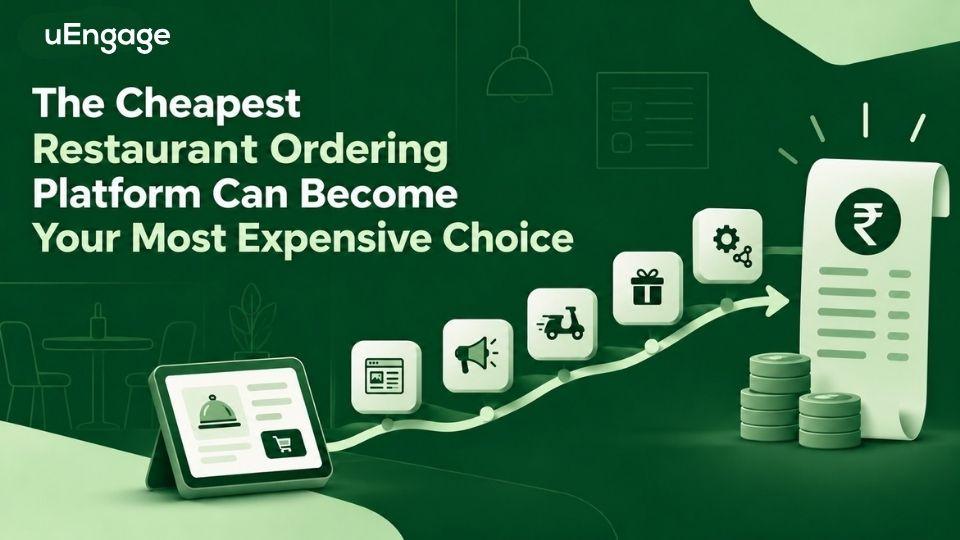
The real cost appears later, when the restaurant needs a custom domain, loyalty, WhatsApp marketing, POS integrations, delivery tracking, multiple outlets or another tool to fill a capability gap.
That is when an inexpensive ordering platform can start becoming an expensive technology stack.
The cheapest platform is not the one with the lowest subscription. It is the one that meets the restaurant’s complete requirements with the least long-term complexity.
This restaurant ordering platform comparison looks at MenuThere, AirMenus and uEngage from that perspective: not simply what each platform costs to start, but what a growing restaurant may need after it begins taking orders.
Pricing and features were reviewed on official pages on 2 November 2026. They may change, so businesses should confirm the final commercial terms directly with each provider.
Why Can a Cheap Restaurant Ordering Platform Become Expensive?
A cheap restaurant ordering platform can become expensive when its starting plan covers only part of the restaurant’s actual requirements.
Setup fees, higher plans, add-ons, integrations, transaction charges and separate tools for marketing, delivery or dine-in operations can all sit on top of the advertised price.
The right comparison is not:
“Which platform has the lowest monthly fee?”
It is:
“What will it cost to run everything our restaurant needs?”
Cheap for Which Restaurant?
There is no universally cheapest restaurant ordering platform.
The right choice depends on what the restaurant needs today and what it is likely to need next.
Restaurant A: A Café That Only Needs a QR Menu
A single-outlet café may only require:
A digital menu
Table QR codes
Basic ordering
Simple payment options
For this business, a free or entry-level plan can be perfectly reasonable.
Paying for advanced delivery, loyalty or multi-outlet capabilities would not make sense if the café does not need them.
Restaurant B: A Delivery-Focused Restaurant
A restaurant that wants to drive direct orders may require:
Its own ordering website
A custom domain
Online payments
Pickup and delivery settings
Customer notifications
POS integration
Delivery-partner integration
This restaurant should compare plans that include all these requirements.
Comparing one provider’s free QR-menu plan with another provider’s complete ordering setup would not be a fair comparison.
Restaurant C: A Growing Multi-Outlet Brand
A growing QSR, bakery or cloud-kitchen brand may need:
Website, app and WhatsApp ordering
Customer data and segmentation
Loyalty and automated campaigns
Feedback and digital bills
Own-fleet and third-party delivery management
Live rider tracking
Reservations and guest queues
POS, payment and logistics integrations
Outlet-level reporting
For this business, the question is not only the subscription price.
The bigger question is:
“How many systems, vendors and manual processes will we need to manage the complete operation?”
MenuThere, AirMenus and uEngage: What Are You Actually Buying?
All three platforms can help restaurants build direct digital channels, but their scope and ideal use cases differ.
Platform | May suit restaurants that… | What buyers should confirm |
|---|---|---|
MenuThere | Want to begin with online ordering, QR menus and table ordering | Which plan includes riders, loyalty, integrations, marketing and branded capabilities |
AirMenus | Need QR menus, direct ordering, CRM and tier-based marketing capabilities | Which features require Growth, Premium or additional paid add-ons |
uEngage | Need connected Ordering, Marketing, delivery, and Reservation capabilities, all in one connected platform ecosystem | Whether the broader platform scope justifies the higher initial commitment |
This is not about calling one platform suitable for every restaurant. It is about comparing the same requirement across all three.
What the Published Prices Include
MenuThere
MenuThere publishes a free plan and paid monthly tiers.
Its lower plans focus mainly on digital menus and direct ordering, while features such as own-rider tracking, loyalty, branded apps and other advanced capabilities depend on the selected plan.
MenuThere’s public pages currently display some variations in the Lite price, so restaurants should confirm the latest applicable price before deciding.
AirMenus
AirMenus currently publishes four annual plans:
Starter: Rs 12,000 per year
Advance: Rs 18,000 per year
Growth: Rs 25,000 per year
Premium: Rs 30,000 per year
The Starter plan focuses on QR menus, menu management, CRM, reservations and feedback.
Direct ordering starts with the Advance plan. Loyalty, WhatsApp marketing, custom domains, POS integrations and multi-outlet controls are listed under Growth. The website builder is included in Premium.
AirMenus also lists separate add-ons for capabilities such as website building, WhatsApp marketing, custom domains, themes and loyalty.
uEngage
uEngage currently publishes three single-outlet plans:
WebXpress: Rs 21,999 per year
WebXpress + LoyaltyPro: Rs 39,999 per year
AppXpress: Rs 1,24,999 per year
One-time setup charges vary by plan.
uEngage covers a broader restaurant technology stack:
Ordering through website, app, WhatsApp, QR and kiosk
CRM, loyalty and marketing automation
Digital bills, feedback and customer analytics
Own-fleet and third-party delivery management
Live tracking and rider operations
Dine-in, queue and table operations through uServe
A small café may not need this complete setup.
However, for a restaurant planning to manage direct ordering, customer retention, delivery and dine-in operations, the wider platform scope changes the comparison. Instead of adding multiple disconnected tools over time, the restaurant can expand within one connected ecosystem.
Compare the Requirement, Not Just the Starting Price
Restaurant requirement | MenuThere | AirMenus | uEngage |
|---|---|---|---|
Basic digital or QR menu | Available | Starter | Available within the ordering ecosystem |
Direct online ordering | Available in selected plans | Advance or above | WebXpress |
Ordering with loyalty | Depends on selected plan | Growth or relevant add-on | WebXpress + LoyaltyPro |
Branded mobile application | Depends on selected plan | Confirm applicable plan | AppXpress |
Delivery and rider operations | Higher plan or additional capability required | Separate solution may be required | Available through uEngage Delivery |
Self-ordering kiosk | Not publicly listed as a core offering | Not publicly listed as a core offering | Available through uKiosk |
Queue and table operations | Not publicly listed as a core offering | Selected reservation capabilities | Available through uServe |
The relevant question is not:
Which platform advertises the lowest starting price?
It is:
What will the complete setup cost for everything the restaurant actually needs?
A lower entry price can be the right choice for a basic requirement. But if the restaurant later needs a website, loyalty, WhatsApp marketing, delivery software, mobile apps and integrations, the total cost and operational complexity can increase.
The cheapest plan is not necessarily the lowest-cost platform. The real cost depends on the complete system required to operate, retain customers and grow.
Pricing and plan information is based on publicly available details reviewed in November 2026. Features, add-ons, taxes and implementation charges may change. Restaurants should confirm the latest terms directly with each provider.
The Costs That Appear After the Subscription
Add-ons and Plan Upgrades
A restaurant may start with a basic plan and later require:
Custom domain
Loyalty programme
WhatsApp marketing
POS integration
Website builder
Branded mobile app
Multi-outlet controls
Add-ons are not automatically a problem. They allow restaurants to choose what they need.
The problem is discovering their cost only after selecting the platform.
Multiple Software Subscriptions
If ordering, loyalty, delivery and reservations operate through separate tools, the restaurant may pay for:
Ordering software
CRM
Loyalty
Marketing automation
Delivery management
Reservation software
Customer analytics
Integration tools
The original ordering platform may still be inexpensive.
The complete technology stack may not be.
Manual Work Between Disconnected Systems
Disconnected tools create costs that do not appear on an invoice.
Teams may have to:
Export customer lists
Reconcile multiple reports
Update the same information in different systems
Coordinate with multiple support teams
Resolve integration issues manually
Maintain different settings across outlets
The software may be inexpensive. The workflow may not be.
Migration and Retraining
A platform that works for one outlet may not work when the restaurant adds more locations or operational requirements.
Moving later may involve migrating:
Menus
Customer data
Loyalty balances
Ordering links
Payment configurations
Integrations
Staff workflows
Migration has a financial cost, but it also disrupts restaurant operations.
Calculate the Complete Requirement
Restaurants can use this simple calculation:
Complete platform cost = Subscription + Setup + Required add-ons + Integrations + Transaction costs + Additional tools
Operational effort should also be considered, even if it cannot be assigned an exact rupee value.
Before requesting pricing, restaurants should write down everything they need and ask each provider to quote against the same list.
That creates a fairer comparison than placing unrelated plans next to one another.
An Affordable Platform Can Still Be the Right Choice
This is not an argument against affordable restaurant software.
A lower-priced platform may be the right choice when:
The restaurant has one outlet
Its requirements are simple
It needs only a QR menu or basic ordering page
It does not need advanced delivery operations
It does not require connected loyalty and marketing
It is comfortable upgrading or migrating later
The mistake is not choosing an affordable platform.
The mistake is choosing an incomplete platform for a complex operation simply because its first number is lower.
A Useful Idea Can Be Repeated. The System Behind It Cannot.
Restaurant technology products increasingly look similar from the outside.
A search bar can be recreated.
A score can be displayed.
A report can analyse reviews, websites, ordering gaps and nearby competitors.
uEngage’s AURA helps restaurant owners see how customers discover and evaluate their business online. It reviews public signals such as:
Google presence
Customer reviews
Website experience
Direct ordering
Nearby competition
Search visibility
MenuThere’s current Radar page uses a closely related customer promise and report flow, including restaurant-name search, a report in about 60 seconds, public business signals, a score and recommended fixes.
The visible similarity is clear. But the more important difference begins after the report identifies a problem.
A report may find that:
Customers cannot order directly
Previous customers are not returning
Deliveries lack visibility
Guests are waiting without clear queue management
The restaurant then needs a system that can act on those findings.
A diagnostic report is the beginning. Growth depends on the platform available after the diagnosis.
What Happens After the Diagnosis?
If Direct Ordering Is Missing
The restaurant needs ordering channels that match how its customers buy:
Web ordering
Branded mobile apps
WhatsApp ordering
QR ordering
Self-ordering kiosks
If Customers Are Not Returning
The restaurant needs:
Customer data
Segmentation
Loyalty
Automated campaigns
Digital bills
Feedback management
If Delivery Operations Are Breaking
The restaurant may need:
Own-rider management
Third-party delivery partners
Rider allocation
Live delivery tracking
Route optimisation
Delivery analytics
If Dine-in Guests Are Waiting
The restaurant may require:
Guest check-ins
Live queues
Table allocation
Floor visibility
Waiter-to-kitchen order movement
A useful front-end idea can be repeated. Sustainable growth comes from the infrastructure behind it.
Where uEngage Fits
uEngage brings four restaurant requirements together.
Ordering
Restaurants can accept direct orders through website, app, WhatsApp, QR menus and self-ordering kiosks.
Marketing
Customer data can support CRM, loyalty, campaigns, digital bills, feedback and analytics.
Delivery
Restaurants can manage their own riders and third-party delivery partners, along with allocation, tracking and delivery performance.
Reservation and Dine-in
Through uServe, restaurant teams can manage guest check-ins, live queues, tables and waiter-to-kitchen movement.
The value is not simply the number of features.
It is that orders, customers, campaigns, deliveries and dine-in activity can work within one restaurant growth platform.
7 Important Questions to Ask Before Choosing a Platform
Which plan includes everything on our requirements list?
Which capabilities need a higher plan or paid add-on?
Are setup, migration and training charged separately?
Is the price for one outlet or multiple outlets?
Does it integrate with our existing POS, payments and delivery partners?
Can we export our customer and loyalty data if we leave?
What will the complete setup cost now and after we add more outlets?
Ask every vendor for these answers in writing.
Final Takeaway
MenuThere, AirMenus and uEngage are not identical products with different price tags.
They represent different levels of platform depth and different ideal use cases.
A restaurant starting with a basic ordering page may reasonably prioritise affordability.
A growing brand managing multiple outlets, customer retention, delivery operations and dine-in experiences needs to evaluate a wider requirement.
That is why the cheapest restaurant ordering platform can become the most expensive choice, not because affordable software is inherently limited, but because an incomplete system becomes costly when the restaurant outgrows it.
Compare what is included.
Compare what needs to be added later.
And compare the platform your restaurant will need next, not only the one it can buy today.
Build for the Next Stage of Growth
uEngage connects Ordering, Marketing, Delivery and Reservation in one restaurant growth platform.