Every restaurant owner has said this at some point:
“We need more riders.”
Late deliveries.
Missed orders.
Angry customers.
Confused staff.
And the default reaction?
Hire more riders.
Add another delivery partner.
Increase incentives.
But in 2026, the smartest restaurant brands have realised something important:
Rider chaos is not a staffing issue.
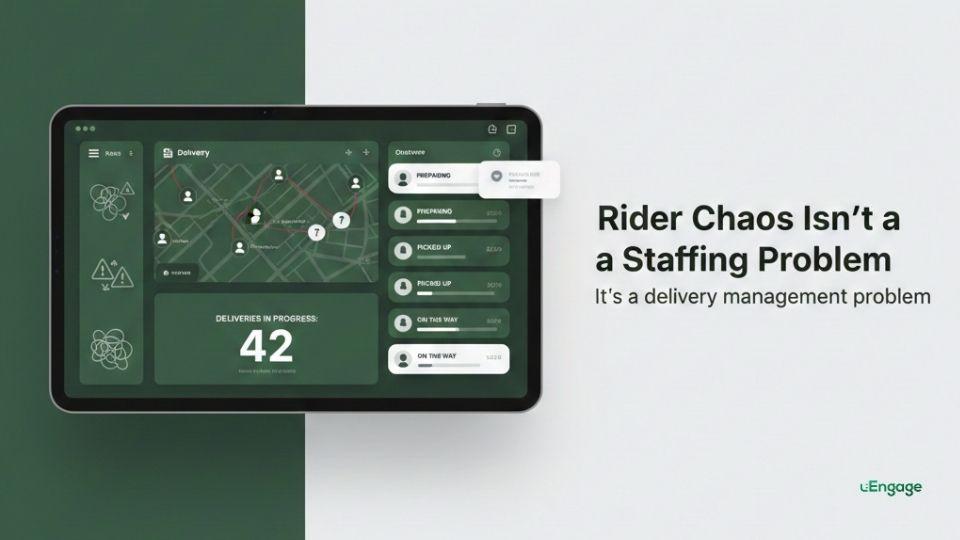
It’s a delivery management issue.
More riders don’t fix broken systems.
Better management does.
The Myth: “If We Had More Riders, Deliveries Would Be Smooth”
This belief is everywhere.
When orders spike:
-
Riders feel overwhelmed
-
Orders pile up
-
Dispatch becomes messy
So restaurants assume the problem is manpower.
But here’s the reality
Industry insight
-
Restaurants with excess riders still report 25–40% delivery delays
-
Adding riders increases cost by 15–30%, with minimal improvement in SLA
-
Most delivery failures happen due to poor allocation, visibility, and coordination
In other words:
Chaos doesn’t come from shortage. It comes from lack of control.
Where Rider Chaos Actually Begins
Let’s break it down honestly.
1. No Centralised Delivery View
In many restaurants:
-
Orders come from multiple channels
-
Riders are tracked manually
-
Status updates are scattered
No one sees:
-
Which rider is free
-
Which order is delayed
-
Which delivery partner is overloaded
Without a proper delivery management software, teams operate blindly.
“If you can’t see the system, you can’t fix it.”
2. Manual Assignment Creates Bottlenecks
When delivery assignment depends on:
-
Phone calls
-
WhatsApp messages
-
Human judgement
Errors are inevitable.
Common issues:
-
Wrong rider assigned
-
Delayed dispatch
-
Duplicate effort
Smart restaurants use delivery management software to automate assignment based on:
-
Distance
-
Availability
-
Load
3. Riders Waste Time, Not Distance
Most delays are not because riders travel far.
They happen because:
-
Riders wait for instructions
-
Orders aren’t ready on time
-
There’s confusion at pickup
Studies show riders spend 20–30% of delivery time idle, not riding.
This is a system problem, not a staffing problem.
4. No Real-Time Tracking = No Accountability
Without live tracking:
-
Managers don’t know what’s stuck
-
Riders can’t be optimised
-
Customers get no updates
Lack of visibility creates panic and finger-pointing.
A strong delivery management software brings transparency across:
-
Kitchen
-
Rider
-
Customer
5. Multi-Location Chaos Multiplies the Problem
For growing brands, chaos scales fast.
Multiple outlets mean:
-
Different rider pools
-
Inconsistent processes
-
Zero standardisation
Without unified delivery control, scale breaks operations.
This is why enterprise brands prioritise delivery management software for restaurants early.
Real Restaurant Scenario
A QSR chain expanded to 12 locations.
Problems they faced:
-
High rider churn
-
Late deliveries
-
Customer complaints rising
They kept hiring riders, but nothing changed.
After implementing a proper delivery management software:
-
Riders were optimally assigned
-
Delays were identified early
-
Managers had one dashboard
Results:
-
Fewer riders needed
-
Faster delivery times
-
Better rider satisfaction
The chaos didn’t disappear because of people.
It disappeared because of process.
Why Hiring More Riders Makes Chaos Worse
Here’s the uncomfortable truth:
More riders poor systems = more confusion.
Problems that increase:
-
Higher cost
-
Harder coordination
-
Lower accountability
Restaurants that rely only on manpower see operational costs rise faster than revenue.
Systems scale.
People burn out.
What Smart Restaurants Do Differently in 2026
Winning brands treat delivery like an operation, not an afterthought.
1. Centralised Delivery Control
They manage:
-
All orders
-
All riders
-
All partners
From one delivery management platform.
This eliminates blind spots.
2. Intelligent Rider Allocation
Instead of manual dispatch:
-
Orders auto-assign
-
Load is balanced
-
Idle time is reduced
This is where modern delivery management software shines.
3. Real-Time Delivery Tracking
Live visibility allows:
-
Early delay detection
-
Proactive customer updates
-
Operational clarity
Tracking isn’t for customers alone, it’s for managers.
4. Performance Insights That Matter
Smart systems show:
-
Rider efficiency
-
Delay patterns
-
Peak-time bottlenecks
This turns chaos into actionable data.
Why 2026 Demands Smarter Delivery Systems
Customer patience is shrinking.
Key stats:
-
45% customers won’t reorder after one late delivery
-
60% expect real-time updates
-
Brands with predictable delivery see 20–25% higher repeat orders
“Customers forgive late food less than bad food.”
Delivery experience is brand experience.
How uEngage Flash Solves Rider Chaos
uEngage Flash is built to fix delivery chaos at the root.
It helps restaurants:
-
Centralise delivery operations
-
Assign riders intelligently
-
Track deliveries in real time
-
Reduce dependency on manual coordination
Flash turns delivery from reactive firefighting into controlled execution.
Final Thoughts
If your delivery feels chaotic, ask yourself:
Is it really a rider problem?
Or a management problem?
In 2026, restaurants that scale successfully understand one thing:
You don’t need more riders.
You need better delivery management.
Because chaos doesn’t come from people.
It comes from broken systems.
And systems can be fixed.