For many restaurant brands, delivery growth starts simple:
Add a courier partner. Use a route tool. Ship faster.
But as volumes increase, something breaks.
Delays increase.
Costs fluctuate.
Rider productivity drops.
Customers complain.
That’s when restaurants realise a hard truth:
A generic logistics tool is not the same as a delivery route planner for restaurants.
And the difference directly impacts speed, cost, and control.
What Is a Delivery Route Planner for Restaurants?
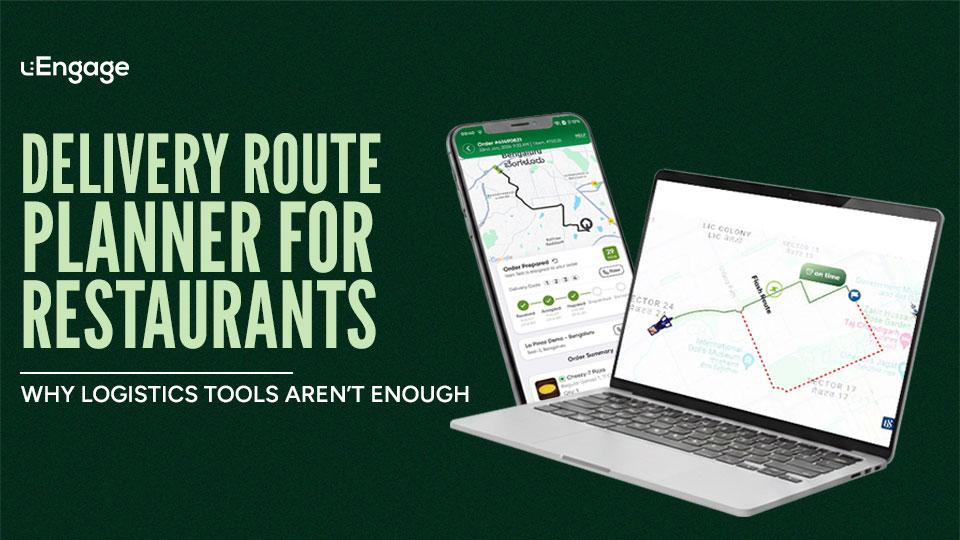
A delivery route planner for restaurants is not just a mapping tool.
It is a system designed specifically for food delivery operations where:
-
Orders are time-sensitive
-
Delivery windows are tight
-
Customer experience is critical
-
In-house and 3PL fleets operate together
Unlike traditional logistics software built for parcels, restaurant delivery requires dynamic decision-making in real time.
“In food delivery, a 10-minute delay isn’t a delay. It’s a lost customer.”
Why Generic Logistics Tools Fall Short
Most logistics tools are built for:
-
E-commerce shipping
-
Courier aggregation
-
Bulk parcel movement
But restaurants operate differently.
1. They Need Time-Based Routing, Not Just Distance-Based
Food delivery is about freshness.
Optimising for shortest distance isn’t enough, timing matters more.
A specialised delivery route planner for restaurants prioritises:
-
Delivery SLAs
-
Order preparation time
-
Rider availability
-
Peak-hour traffic logic
Generic route planners don’t consider kitchen workflows.
2. They Manage Mixed Fleets
Growing restaurants don’t rely on just one delivery method.
They operate:
-
In-house riders
-
Third-party delivery partners
-
On-demand logistics APIs
A true delivery route planner for restaurants allows centralised control across all these layers — not multiple dashboards.
This unified model reduces operational friction and manual coordination.
3. They Require Real-Time Intervention
Static route mapping is outdated.
Modern delivery operations demand:
-
Real-time route optimisation
-
Automatic reassignment
-
SLA monitoring
-
Delivery performance tracking
According to industry logistics studies, real-time route optimisation can reduce delivery time by 15–25% and improve fleet efficiency by nearly 30%.
That’s not a mapping improvement.
That’s operational impact.
The Real Benefits of a Restaurant-Focused Route Planner
Let’s break this down clearly.
Faster Deliveries Without Rider Chaos
A structured delivery route planner for restaurants reduces overlapping assignments and idle time.
Riders spend more time delivering, less time waiting.
Lower Cost Per Delivery
Fuel inefficiency and poor routing inflate delivery costs.
Smart route optimisation ensures:
-
Fewer unnecessary kilometres
-
Better load balancing
-
Predictable rider utilisation
Small routing improvements can reduce cost per delivery by 10–20% over time.
Full Operational Visibility
Restaurants need more than tracking pins.
They need:
-
Route efficiency reports
-
Rider performance metrics
-
Zone-wise delay analysis
This is where route planning connects with broader delivery operations management.
“Visibility shows you where things went wrong. Control helps you prevent it.”
Why Restaurants Need More Than a Courier Dashboard
Courier-focused platforms optimise for shipment flow.
Restaurants need optimisation for experience flow.
Food delivery isn’t about moving packages.
It’s about protecting brand trust.
A purpose-built delivery route planner for restaurants integrates with:
-
Order management systems
-
Kitchen workflows
-
Real-time delivery tracking
-
Customer notifications
This alignment ensures delivery becomes an extension of the restaurant, not a disconnected logistics layer.
How Restaurant Delivery Has Evolved
Earlier, delivery was an add-on.
Today, it’s a core revenue driver.
Industry data shows delivery contributes up to 40–60% of revenue for many QSR and cloud kitchen brands.
At that scale, route inefficiencies aren’t minor, they’re margin killers.
That’s why delivery optimisation must be restaurant-first.
The Flash Approach: Built for Restaurant Operations
This is where platforms like uEngage Flash differentiate.
Instead of being a shipping tool adapted for food, Flash is designed around:
-
Multi-location restaurant operations
-
Mixed fleet management
-
Real-time delivery tracking
-
Route optimisation aligned with order flow
It’s not about adding another dashboard.
It’s about unifying delivery logic under one system.
Not louder logistics.
Smarter routing.
Final Takeaway
Logistics tools are built to move parcels.
Restaurants need systems that move orders with speed, accuracy, and consistency.
The real advantage of a delivery route planner for restaurants isn’t just faster routes, it’s operational control, cost predictability, and customer trust.
Because in restaurant delivery, efficiency isn’t optional.
It’s the difference between scaling smoothly, and scaling into chaos.