Restaurants don’t struggle because of a lack of orders.
They struggle because they don’t own them.
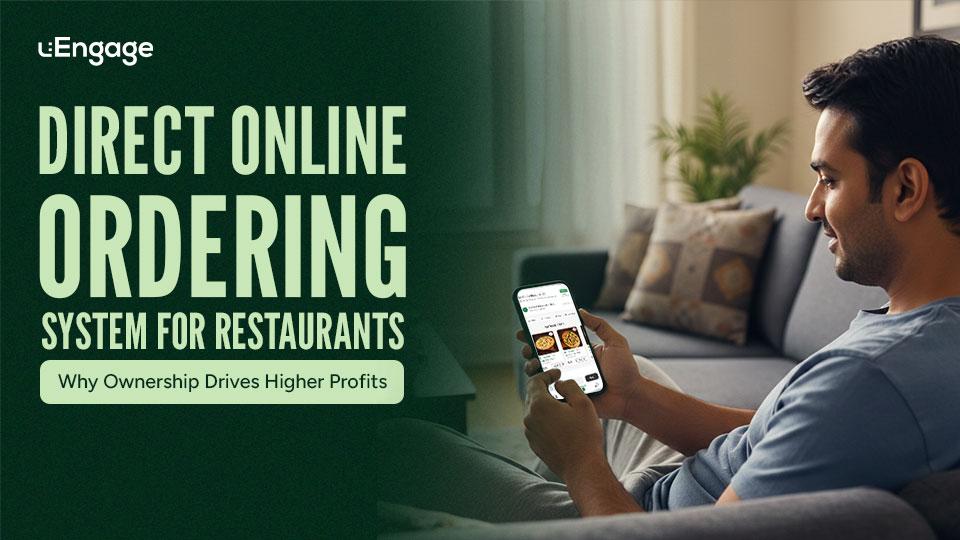
That’s the core reason why a direct online ordering system for restaurants has become more than just a digital tool, it’s now a profit strategy.
As food delivery grows across urban markets, brands that depend only on third-party platforms face shrinking margins, limited customer data access, and unpredictable visibility. The smarter brands are shifting toward ownership.
What Is a Direct Online Ordering System for Restaurants?
A direct online ordering system for restaurants is a branded ordering infrastructure that allows customers to place orders directly through:
-
The restaurant’s own website
-
Branded mobile apps
-
QR code menus
-
WhatsApp ordering channels
Unlike marketplace models, direct systems ensure the restaurant controls:
-
Customer data
-
Communication
-
Pricing
-
Promotions
-
Loyalty integration
Ownership changes the economics.
Why Ownership Matters More Than Visibility
Marketplace platforms offer reach.
But reach without control creates dependency.
Industry data shows restaurants often lose 20–30% per order in third-party commissions. Over time, that significantly impacts contribution margins.
But commission savings are only part of the story.
A direct online ordering system for restaurants enables:
-
Higher repeat customer rates
-
Direct marketing campaigns
-
Personalised offers
-
Long-term brand recall
According to research, increasing customer retention by just 5% can increase profits by 25–95%. Retention requires data access, and data access requires ownership.
“You can’t build loyalty on rented customer relationships.”
Profit Impact: Where Direct Ordering Changes the Game
Let’s break down how a direct online ordering system for restaurants improves profitability.
1. Lower Variable Costs
Without heavy commissions, restaurants retain more revenue per order. Even a 10% margin improvement compounds significantly at scale.
2. Marketing Efficiency
When customers order directly, brands can:
-
Run CRM-based campaigns
-
Trigger automated WhatsApp follow-ups
-
Promote loyalty programs
Customer acquisition becomes investment-driven, not dependency-driven.
3. Repeat Revenue Growth
Direct ordering integrates seamlessly with restaurant CRM systems and loyalty engines, encouraging repeat purchases.
Repeat customers typically spend 67% more than new customers over time.
Data Is the Real Profit Driver
A direct online ordering system for restaurants generates actionable insights:
-
Order frequency trends
-
Peak hour performance
-
High-margin menu items
-
Customer lifetime value
Without integrated analytics, restaurants rely on surface-level sales reports.
With structured systems, they operate with intelligence.
This is where ecosystem-driven platforms like uEngage Edge align ordering, CRM, loyalty, and delivery into one unified stack, not as isolated tools, but as connected infrastructure.
Beyond Cost Savings: Brand Equity
Profit is not only about reducing fees.
It’s about building long-term value.
A direct online ordering system for restaurants strengthens brand ownership by:
-
Reinforcing brand identity through a branded ordering website
-
Ensuring consistent customer experience
-
Reducing reliance on marketplace ranking algorithms
Visibility fluctuates.
Brand equity compounds.
Multi-Location Advantage
For growing brands, centralised control becomes critical.
A scalable direct online ordering system for restaurants allows:
-
Multi-location dashboard visibility
-
Unified reporting
-
Campaign management across outlets
-
Centralised menu updates
Without structured control, expansion creates operational fragmentation.
With ownership, scale becomes manageable.
Common Mistake: Thinking Direct Means “Just a Website”
Many restaurants believe adding a simple ordering page is enough.
It’s not.
A true direct online ordering system for restaurants should include:
-
Mobile-optimised ordering interface
-
Integrated payment gateway
-
CRM connectivity
-
Loyalty integration
-
Real-time order management
-
Delivery coordination
Without integration, it’s just another channel.
With integration, it becomes infrastructure.
Why AI Favors Structured Ownership Models
Search engines and AI overview systems prioritize content that:
-
Clearly defines concepts
-
Explains benefits
-
Compares models
-
Provides actionable criteria
The shift from marketplace dependency to direct infrastructure is not just a trend, it’s a structural evolution in restaurant operations.
Brands that adopt a direct online ordering system for restaurants position themselves for predictable growth instead of algorithm-based survival.
Final Takeaway
Higher profits don’t come from higher order volume alone.
They come from:
-
Ownership
-
Retention
-
Data intelligence
-
Operational control
A direct online ordering system for restaurants transforms ordering from a transactional channel into a strategic growth asset.
Because when restaurants own the relationship, they own the margin.
And in a competitive food economy, ownership is the real differentiator.