
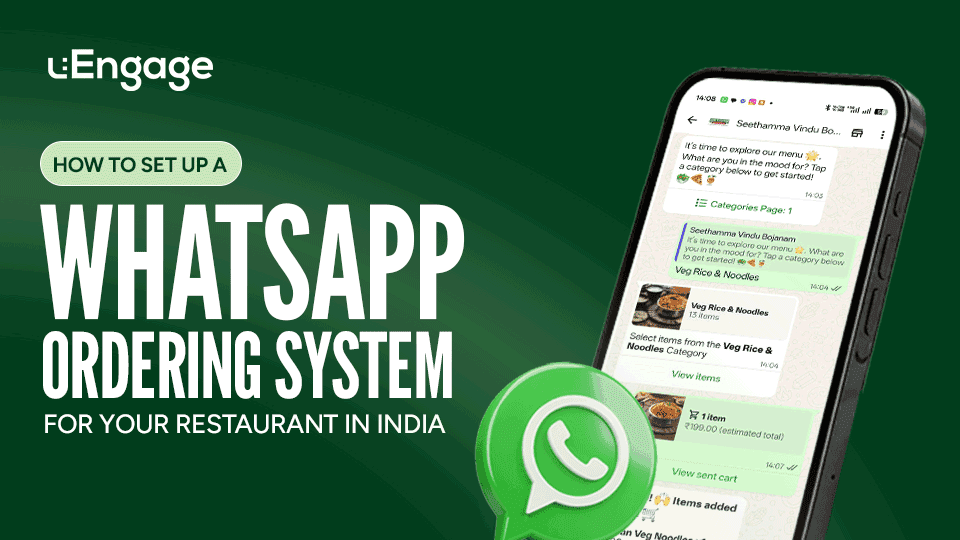
A few years ago, restaurants were trying to get customers to download apps.
Now?
Customers just want one thing:
fast ordering without friction.
That’s exactly why WhatsApp ordering systems for restaurants are growing so fast in India.
No app installs.
No complicated steps.
No switching platforms.
Just:
Chat → Order → Payment → Confirmation
But here’s the catch.
Most restaurants think WhatsApp ordering simply means:
“Take orders on WhatsApp manually.”
It doesn’t.
A proper WhatsApp food ordering system is much bigger than that, and if set up correctly, it can become one of your strongest direct ordering channels.
Let’s break down how restaurants in India are actually setting it up in 2026.
What Is a WhatsApp Ordering System for Restaurants?
A WhatsApp ordering system allows customers to:
-
Browse your menu
-
Place food orders
-
Make payments
-
Receive confirmations and updates
All directly inside WhatsApp.
Instead of redirecting customers to multiple apps or websites, the ordering journey becomes simple and familiar.
For restaurants, this means:
-
More direct orders
-
Better customer retention
-
Lower dependency on third-party platforms
Why Restaurants in India Are Moving to WhatsApp Ordering
Let’s be honest.
Most restaurants don’t have an “order” problem anymore.
They have a:
-
commission problem
-
retention problem
-
customer ownership problem
Food delivery apps help with discovery, but they also take a significant percentage from every order.
That’s why restaurants across India, from QSR chains to cloud kitchens, are investing in direct ordering systems powered by WhatsApp.
According to multiple industry reports, WhatsApp has over 500 million users in India, making it one of the most accessible customer communication channels for restaurants.
And unlike emails…
WhatsApp messages actually get opened.
Benefits of Setting Up a WhatsApp Ordering System
1. Increase Direct Orders
Customers can order directly from your restaurant instead of going through aggregators.
That means:
-
better margins
-
more control
-
stronger repeat business
2. Improve Repeat Orders
A proper restaurant WhatsApp ordering system doesn’t stop at ordering.
It also helps with:
-
offers
-
reactivation campaigns
-
festival promotions
-
loyalty communication
3. Faster Customer Experience
Nobody wants:
-
app downloads
-
OTP logins
-
long checkout flows
WhatsApp ordering removes friction.
4. Own Customer Data
One of the biggest advantages of a WhatsApp ordering platform is customer ownership.
You know:
-
who ordered
-
what they ordered
-
how often they return
That’s difficult to achieve through third-party marketplaces alone.
Step-by-Step: How to Set Up a WhatsApp Ordering System
Step 1: Choose the Right WhatsApp Ordering Platform
This is the most important step.
Avoid setups that only support:
-
manual chats
-
PDF menus
-
disconnected payment links
A proper platform should include:
-
menu integration
-
order flow
-
payment support
-
CRM integration
-
campaign tools
This is where many restaurants choose a dedicated WhatsApp ordering system for restaurants instead of using basic WhatsApp Business accounts.
Step 2: Upload and Organize Your Menu
Your menu should be:
-
mobile-friendly
-
category-based
-
visually clear
-
easy to browse
Popular categories usually include:
-
pizzas
-
burgers
-
combos
-
beverages
-
desserts
The simpler the browsing experience, the higher the conversion rate.
Step 3: Add Payment Integration
Customers should be able to:
-
pay via UPI
-
use cards
-
complete transactions instantly
Complicated payment flows increase drop-offs.
Step 4: Connect Your Ordering Workflow
A structured WhatsApp ordering setup should connect with:
-
kitchen operations
-
POS systems
-
order management dashboards
-
delivery tracking
This reduces manual errors and improves operational speed.
Step 5: Automate Customer Communication
This is where WhatsApp ordering becomes powerful.
You can automate:
-
order confirmations
-
delivery updates
-
coupon campaigns
-
repeat order reminders
-
feedback requests
Restaurants using automation often see better retention compared to manual ordering setups.
Common Mistakes Restaurants Make While Setting Up WhatsApp Ordering
Using Only Manual Chats
Manual ordering works for small volume.
But once orders increase?
It becomes chaotic.
No Structured Ordering Flow
Customers should not feel confused about:
-
where to click
-
how to pay
-
how to confirm orders
Ignoring Customer Retention
WhatsApp is not just an ordering tool.
It’s also a retention and engagement channel.
How Much Does a WhatsApp Ordering System Cost in India?
Costs usually depend on:
-
number of outlets
-
API usage
-
automation features
-
integrations
Typical costs may include:
-
setup fees
-
WhatsApp API charges
-
platform subscription
-
payment gateway fees
But compared to high marketplace commissions…
many restaurants see WhatsApp ordering as a long-term profitable investment.
Is WhatsApp Ordering Better Than Food Delivery Apps?
Not exactly.
The smartest restaurants use both.
Aggregators help with:
-
discovery
-
new customer reach
WhatsApp ordering helps with:
-
repeat customers
-
direct ordering
-
retention
-
better margins
The real growth comes from balancing both channels strategically.
What Should Restaurants Look for in a WhatsApp Ordering System?
Before choosing a platform, check for:
-
menu management
-
payment integration
-
POS compatibility
-
customer data tracking
-
marketing automation
-
loyalty integrations
-
delivery tracking
-
campaign support
A strong system should help restaurants move from:
“taking orders”
to
“building customer relationships.”
Final Thoughts
Setting up a WhatsApp ordering system is no longer just about convenience.
For many restaurants in India, it’s becoming a serious business growth channel.
Because the goal today isn’t just getting orders.
It’s:
-
owning customer relationships
-
improving repeat business
-
increasing direct revenue
-
reducing dependency on marketplaces
And that shift starts with building a smarter ordering system.