Speed alone doesn’t define success in food delivery.
Reliability does.
Control does.
Operational intelligence does.
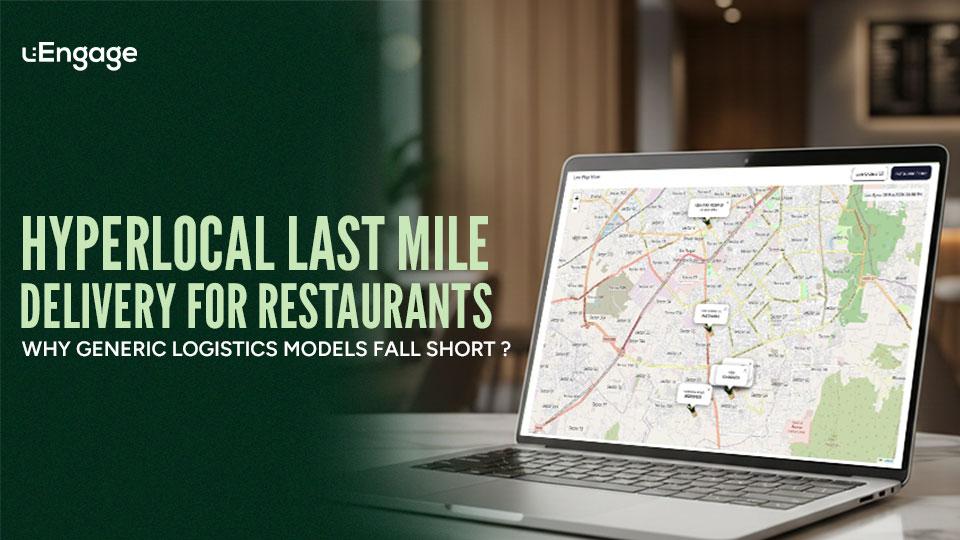
That’s why hyperlocal last mile delivery for restaurants is fundamentally different from traditional courier logistics. And yet, many restaurant brands still rely on generic logistics platforms that were never built for food-first operations.
The result? Delays, inconsistent costs, and frustrated customers.
What Makes Hyperlocal Last Mile Delivery Different?
At a glance, last mile delivery seems simple: pick up, deliver, close the order.
But hyperlocal last mile delivery for restaurants operates under unique constraints:
-
Orders are time-sensitive
-
Food freshness matters
-
Customer tolerance is low
-
Delivery volume fluctuates hourly
Unlike parcel shipping, restaurants deal with real-time pressure.
“In food delivery, a 15-minute delay doesn’t just affect one order. It affects brand perception.”
That’s where generic courier models start falling short.
Why Generic Logistics Models Don’t Work for Restaurants
Most logistics companies are optimised for:
-
E-commerce parcels
-
Bulk shipping
-
Warehouse dispatch
But restaurants require:
-
SLA-based routing
-
Kitchen-to-door coordination
-
Mixed fleet management (in-house 3PL)
-
Real-time delivery tracking
Generic systems optimise for distance.
Restaurants need optimisation for time experience.
This is where hyperlocal last mile delivery for restaurants demands a different infrastructure.
The Scale Problem: Delivery Is Now Core Revenue
Delivery is no longer an add-on channel.
Industry reports show that delivery contributes 40–60% of total revenue for QSRs and cloud kitchens in urban markets. In some hyperlocal-heavy brands, it’s even higher.
At that scale, inefficiencies compound fast.
Even a 10% delay increase can:
-
Reduce repeat orders
-
Increase refund requests
-
Lower customer ratings
That’s why structured hyperlocal last mile delivery for restaurants isn’t optional anymore, it’s revenue protection.
What Restaurants Actually Need from Hyperlocal Last Mile Delivery
Let’s break it down clearly.
1. Real-Time Route Optimisation
Traffic-based rerouting and SLA prioritisation are critical.
Studies suggest dynamic route optimisation can improve delivery time by 15–25% and reduce fuel costs by nearly 20%.
But many courier-first platforms still use static routing logic.
2. Mixed Fleet Coordination
Growing restaurants rarely rely on a single delivery source.
They manage:
-
In-house riders
-
Hyperlocal delivery partners
-
Third-party logistics APIs
Effective hyperlocal last mile delivery for restaurants must unify these layers under one operational dashboard.
Multiple dashboards = operational chaos.
3. Delivery Performance Insights
Restaurants don’t just need tracking pins.
They need:
-
Rider performance metrics
-
Zone-wise delay analysis
-
Cost-per-delivery visibility
-
Delivery operations management insights
Without these, scaling becomes guesswork.
“Visibility tells you what happened. Insight tells you what to fix.”
Hyperlocal Isn’t Just About Distance, It’s About Density
One of the biggest misconceptions about hyperlocal delivery is that it’s only about short distances.
In reality, hyperlocal last mile delivery for restaurants is about density:
-
High order clusters
-
Peak-hour spikes
-
Route batching
-
Load balancing
Courier networks often optimise for spread-out parcels. Restaurants need optimisation for clustered, high-frequency orders.
Different problem. Different solution.
Cost Predictability Matters More Than Low Base Rates
Many restaurant operators choose logistics vendors based on low advertised rates.
But real cost includes:
-
Delayed deliveries
-
Failed attempts
-
Rider idle time
-
Customer churn
Poorly managed hyperlocal delivery increases hidden costs.
A structured system reduces volatility and improves predictability, something generic courier systems rarely prioritise.
The Restaurant-First Approach
Modern platforms designed for hyperlocal last mile delivery for restaurants integrate:
-
Online ordering systems
-
Kitchen workflows
-
Real-time tracking
-
Delivery fleet management
-
Centralised dashboards
This alignment ensures delivery becomes an extension of restaurant operations, not a disconnected vendor layer.
This is where restaurant-focused ecosystems like uEngage Flash differentiate quietly, by unifying route optimisation, fleet visibility, and SLA control under one system.
Not louder logistics.
Smarter operations.
The Real Difference: Vendor vs Infrastructure
Generic logistics companies act as vendors.
Restaurant-first hyperlocal systems act as infrastructure.
Infrastructure scales.
Vendors need constant coordination.
As delivery volume grows, only structured hyperlocal last mile delivery for restaurants models can maintain speed, cost efficiency, and customer satisfaction simultaneously.
Final Takeaway
Hyperlocal delivery isn’t just about being fast within a radius.
It’s about:
-
Precision
-
Control
-
Coordination
-
Predictability
And generic logistics platforms weren’t built for that.
Restaurants that invest in proper hyperlocal last mile delivery for restaurants infrastructure don’t just deliver faster, they scale cleaner.
Because in restaurant delivery, operational control isn’t a feature.
It’s a competitive advantage.