Delivery growth has changed restaurant economics.
In many urban markets, delivery contributes 40–60% of total revenue for QSRs and cloud kitchens. But while revenue increases, margins often shrink, and the biggest reason sits in the final stretch of the order journey.
That stretch is the last mile.
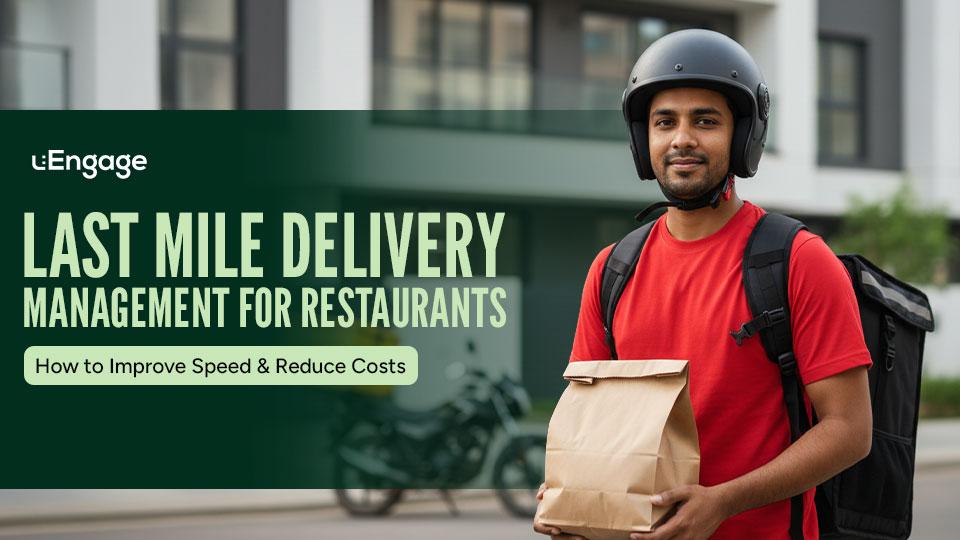
Effective last mile delivery management for restaurants determines whether brands scale profitably or bleed silently through operational inefficiencies.
Why the Last Mile Is Operationally Different for Restaurants
Unlike e-commerce parcels, food delivery operates under strict constraints:
-
Perishable product
-
Narrow delivery windows
-
High customer expectation
-
Peak-hour order clustering
A study by McKinsey estimated that last mile delivery can account for up to 50% of total logistics costs. For restaurants, this percentage can feel even higher due to time sensitivity and rider utilisation issues.
“In food delivery, a small delay creates a large perception problem.”
That’s why structured last mile delivery management for restaurants isn’t optional anymore, it’s foundational.
Speed: The Competitive Advantage Customers Notice First
Consumers today expect faster delivery windows than ever. Industry data shows that delivery time expectations have reduced by nearly 20% in the past five years.
However, faster delivery doesn’t mean simply hiring more riders.
Improving speed requires:
-
Dynamic route optimisation
-
Traffic-aware dispatch systems
-
Intelligent order batching
-
Delivery zone clustering
Research indicates that dynamic route optimisation alone can improve delivery time by 15–25% and reduce fuel costs by 15–20%.
Without structured last mile delivery management for restaurants, speed improvements remain inconsistent and dependent on manual coordination.
Cost Control: The Hidden Leakage Most Brands Ignore
Delivery cost isn’t just the per-order fee.
It includes:
-
Rider idle time
-
Failed delivery attempts
-
Refunds due to delays
-
Surge-based pricing
-
Manual coordination overhead
For multi-location brands, even a ?10–?15 inefficiency per order compounds significantly at scale.
Consider this:
If a restaurant processes 1,000 delivery orders daily, a ?12 inefficiency equals ?12,000 per day, nearly ?3.6 lakh per month.
That’s the real cost of poor systems.
Well-designed last mile delivery management for restaurants helps brands monitor:
-
Cost per delivery
-
Rider productivity
-
Zone-based cost variation
-
In-house vs third-party efficiency
Cost visibility is the first step toward cost reduction.
Reliability Drives Repeat Revenue
Customer retention in food delivery depends heavily on reliability.
According to retention studies, improving delivery consistency increases repeat order probability significantly. Customers who experience on-time delivery are far more likely to reorder within 30 days.
“Customers forgive a bad campaign. They rarely forgive a late meal.”
Reliable last mile delivery management for restaurants ensures:
-
Real-time tracking
-
Automated delay alerts
-
Transparent communication
-
Centralised dispatch visibility
When customers feel informed, even delays feel manageable.
Data: The Difference Between Reaction and Strategy
Many restaurants only measure delivery performance at a surface level:
-
Total orders
-
Average delivery time
But strategic brands analyse:
-
Delivery performance by zone
-
Rider efficiency metrics
-
Peak-hour congestion patterns
-
Delivery-driven repeat behaviour
Advanced systems convert operational data into actionable insight.
For example:
If a particular area consistently causes delays, routing logic can be adjusted or delivery radius refined.
Without analytics integration, operational issues repeat quietly.
The Multi-Location Complexity Factor
For single-outlet restaurants, manual coordination might survive.
For multi-location brands, fragmentation multiplies risk.
Centralised dashboards allow leadership teams to:
-
Compare outlet performance
-
Identify cost anomalies
-
Standardise SLA benchmarks
-
Maintain consistent service quality
Modern platforms like uEngage Flash approach delivery not as a vendor layer, but as an integrated operational stack, aligning route optimisation, fleet management, and reporting in one ecosystem.
Not louder logistics.
Better structure.
From Vendor Dependency to Operational Control
Many brands treat delivery as outsourced responsibility.
But as delivery revenue increases, outsourcing control becomes risky.
Strong last mile delivery management for restaurants shifts the mindset from vendor coordination to infrastructure ownership.
Infrastructure scales.
Vendors fluctuate.
And in competitive markets, consistency builds brand equity.
Final Takeaway
Improving delivery speed is important.
Reducing delivery cost is critical.
But sustaining both requires structure.
With proper last mile delivery management for restaurants, brands can:
-
Improve on-time performance
-
Reduce hidden operational leakages
-
Increase repeat customer rates
-
Scale without chaos
In the delivery-driven economy, the last mile isn’t the end of the journey.
It’s the moment that defines whether customers return.