
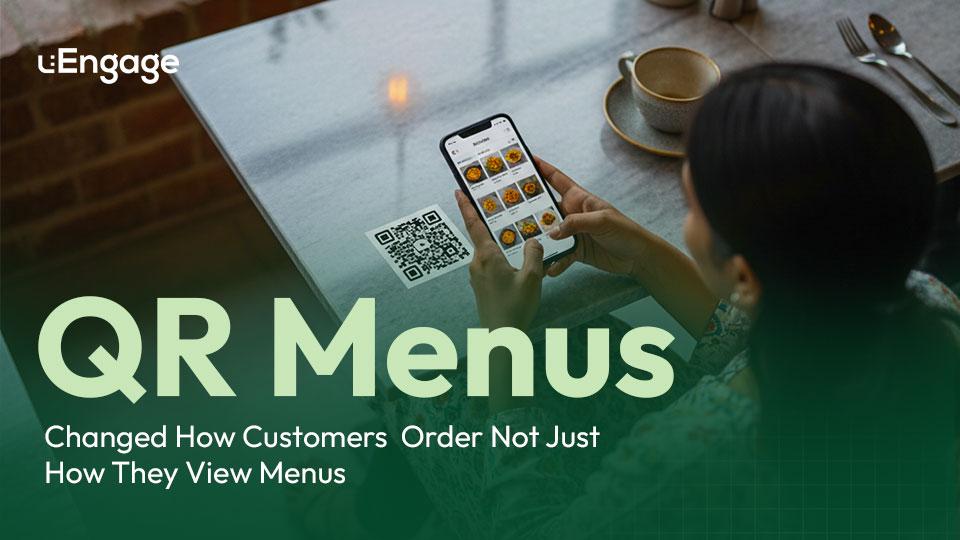
For years, QR code menus were positioned as a convenience feature.
Scan. View. Decide.
But by 2026, something subtle, and far more important, has become clear:
QR menus didn’t just digitize menus.
They quietly rewired how customers think, choose, and order inside restaurants.
What started as a safety-driven shift during the pandemic has now evolved into a behavioural layer of restaurant ordering.
And most restaurants are still underestimating its impact.
The QR Menu Misconception
Ask most restaurant teams why they use QR menus, and you’ll hear answers like:
-
“To avoid printing costs”
-
“To make menus contactless”
-
“Because customers expect it now”
All true.
But incomplete.
Because QR code menus are no longer a viewing tool.
They are now an ordering influence tool.
And that distinction matters.
What Changed: From Menu Access to Decision Flow
Before QR menus:
-
Customers skimmed a physical menu
-
Choices were influenced by visuals, waiter recommendations, and familiarity
-
Ordering followed a linear pattern
After QR menus became mainstream:
-
Customers explore menus at their own pace
-
They scroll, compare, revisit items
-
Decision-making happens before speaking to staff
According to a 2025 hospitality UX study:
“Customers using digital menus spend 32% more time exploring menu options compared to physical menus.”
This alone changed how orders form.
QR Menus Trigger Behavioural Micro-Decisions
Here’s what restaurants often miss:
Ordering is not one decision. It’s a sequence of micro-decisions.
QR menus influence each step:
-
What catches attention first
-
Which items feel “popular”
-
What feels worth the price
-
When the customer feels confident enough to order
This is why a well-designed QR code menu for restaurants can increase basket value without discounts.
Stat That Changes the Conversation
Industry data from India’s QSR and casual dining segment shows:
-
Restaurants using interactive QR menus saw
15–22% increase in average order value -
Table turnover improved by 10–18% during peak hours
-
Menu decision time dropped by up to 25%
QR menus didn’t speed up kitchens.
They reduced hesitation.
Why Static QR Menus Don’t Work Anymore
Many restaurants still use QR menus like scanned PDFs.
That’s a missed opportunity.
Static QR menus:
-
Don’t guide attention
-
Don’t highlight high-margin items
-
Don’t reduce decision fatigue
-
Don’t connect to ordering systems
As one restaurant operator put it:
“We added QR menus, but ordering still felt slow, because nothing changed except the paper.”
QR menus only create impact when they’re designed for behaviour, not just display.
How Smart QR Menus Shape Ordering Decisions
Modern QR menu systems do a few critical things:
1. Visual Hierarchy
Items are structured to guide choices, not overwhelm.
2. Contextual Nudges
Labels like “Most Ordered” or “Chef’s Pick” influence selection.
3. Seamless Transition to Ordering
Customers don’t mentally switch systems between browsing and ordering.
This is where restaurant QR ordering becomes powerful.
The Hidden Link Between QR Menus and Table Turnover
Here’s a counter-intuitive insight:
QR menus don’t rush customers, they reduce indecision.
Customers who decide faster:
-
Order sooner
-
Feel more confident
-
Complete meals more efficiently
According to a 2026 dining behaviour report:
“Restaurants using interactive digital menus experienced smoother table transitions without increasing perceived pressure on diners.”
This is why QR menus quietly improve throughput.
Why QR Menus Are Now Part of the Ordering System
In 2026, QR menus no longer sit before ordering.
They sit inside it.
The best implementations connect QR menus directly to:
-
Web ordering
-
Table ordering
-
Loyalty triggers
-
Kitchen flows
This is where platforms like uEngage Edge position QR menus as a functional ordering layer, not a visual add-on.
The menu doesn’t just show options.
It moves the order forward.
A product leader from a multi-location restaurant chain shared:
“Once we stopped thinking of QR menus as menus and started treating them as part of ordering, everything improved, speed, clarity, and even staff coordination.”
That mindset shift is the real unlock.
Why This Matters for Google & AI Visibility
Search engines and AI systems prioritise content that explains why behaviour changes, not just what tools do.
This blog aligns with AI-overview expectations because it:
-
Explains cause → effect
-
Uses real behaviour patterns
-
Avoids generic feature lists
-
Connects UX to outcomes
That’s exactly why this topic can surface in AI summaries.
The Bigger Takeaway
QR menus didn’t just modernise dining.
They changed how customers:
-
explore
-
decide
-
commit to orders
In 2026, the advantage isn’t having a QR menu.
It’s understanding how it changes ordering behaviour, and designing for it.
Because restaurants that shape decisions don’t need to rush customers.
They simply remove friction.