In 2026, restaurant brands are spending more than ever on ads, influencers, SEO, and marketplace visibility.
Yet growth feels harder.
Orders spike during campaigns… and then disappear.
Traffic increases… but revenue doesn’t follow at the same pace.
According to industry data, over 35–45% of online restaurant orders drop off before checkout, even when demand is high.
This raises a hard truth many brands avoid:
Restaurants don’t lose customers because of lack of traffic.
They lose customers because of broken ordering experiences.
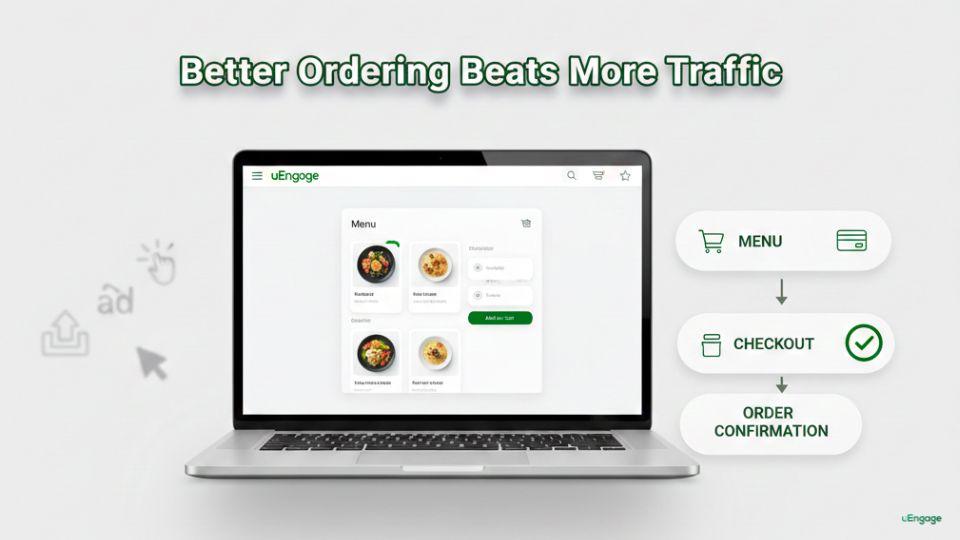
In today’s landscape, better ordering matters more than more eyeballs.
The Traffic Myth Restaurants Still Believe
For years, growth playbooks focused on one thing: bring more users.
More impressions
More clicks
More reach
But traffic alone doesn’t guarantee orders.
A 2025 restaurant commerce study revealed:
-
4 out of 10 customers abandon orders due to checkout friction
-
30% quit because ordering takes “too many steps”
-
Mobile ordering drop-offs are 2× higher on poorly optimised flows
This means restaurants already have demand, they’re just failing to convert it.
That’s where the restaurant ordering website becomes critical.
Ordering Is Not a Feature, It’s the Revenue Engine
Most brands still treat ordering as a functional requirement:
“We already have an ordering system. It works.”
But in reality, ordering is where:
-
Revenue is won or lost
-
Customer trust is built or broken
-
Repeat behaviour is decided
Your online ordering website is not just a transaction layer, it’s the front door of your brand.
“If ordering feels hard, customers assume the brand will be hard too.”
Where Most Ordering Experiences Break Down
Even high-traffic restaurants lose orders because of avoidable issues:
1. Slow Load Times on Mobile
Over 70% of restaurant orders now come from mobile.
A delay of even 2–3 seconds increases abandonment dramatically.
2. Confusing Menus & Poor UX
Too many categories, unclear modifiers, cluttered layouts, all slow decision-making.
3. Forced Logins & Long Forms
Customers don’t want to “create accounts” when they’re hungry.
4. No Visibility Post-Order
Lack of order tracking and updates creates anxiety, and reduces reorders.
These problems don’t come from lack of traffic.
They come from weak ordering infrastructure.
Why Better Ordering Beats More Marketing
Let’s compare outcomes:
| Focus Area | Result |
|---|---|
| More traffic | Higher ad costs, unstable ROI |
| Better ordering | Higher conversion, higher AOV |
| More promotions | Margin pressure |
| Better checkout UX | Faster decisions |
| More platforms | Fragmented experience |
| Direct ordering website | Ownership & repeat orders |
A high-performing restaurant ordering website can improve:
-
Conversion rates by 20–35%
-
Repeat orders by 25–40%
-
Marketing efficiency without increasing spend
This is why smarter brands are shifting focus from acquisition to experience.
The Shift Toward Direct Ordering Websites
In 2026, restaurant growth leaders are investing in:
-
Direct ordering websites
-
Mobile-first checkout flows
-
WhatsApp & app-based ordering extensions
-
Unified order visibility
Why?
Because direct ordering websites allow brands to:
-
Own customer data
-
Control checkout experience
-
Reduce dependency on aggregators
-
Improve margins
This is where platforms like uEngage Edge fit into the picture.
What “Better Ordering” Actually Means in 2026
Better ordering is not about adding features, it’s about removing friction.
Modern restaurant ordering systems focus on:
-
Fast-loading mobile UX
-
Clean, intuitive menus
-
One-tap reordering
-
Multiple ordering channels (web, app, WhatsApp)
-
Real-time order tracking
“Customers don’t want innovation. They want convenience.”
A strong online ordering platform for restaurants should quietly do its job, without customers noticing the technology at all.
The Cost of Ignoring Ordering Experience
Here’s the real risk:
When ordering fails,
-
Marketing ROI drops
-
Loyalty programs underperform
-
CRM insights lose relevance
-
Growth becomes unpredictable
A study on restaurant retention showed:
Customers who have a smooth first ordering experience are 2.6× more likely to reorder within 30 days.
That means your first checkout experience decides long-term value.
Why Traffic-First Thinking Is Outdated
Traffic is rented.
Experience is owned.
In 2026:
-
Ads get more expensive
-
Attention spans get shorter
-
Customers expect instant gratification
Restaurants that win are not the loudest, they are the smoothest.
“Growth doesn’t come from more people entering the funnel.
It comes from fewer people leaking out.”
How Smart Brands Are Fixing This
Forward-thinking restaurants are:
-
Auditing their ordering drop-offs
-
Investing in better ordering websites
-
Simplifying checkout flows
-
Integrating ordering with CRM & loyalty
-
Using platforms like uEngage Edge to unify ordering across channels
This creates:
-
Higher order completion
-
Better repeat behaviour
-
Stronger customer ownership
Final Thought
In 2026, restaurants don’t need:
-
More traffic
-
Louder ads
-
More tools
They need better ordering.
Because no matter how strong your marketing is,
every order still has to pass through the checkout screen.
And that screen decides everything.