Running restaurant deliveries with phone calls, spreadsheets and multiple partner dashboards may work for a few daily orders. But once volumes grow, the same process creates delayed assignments, idle riders, missed status updates and unhappy customers.
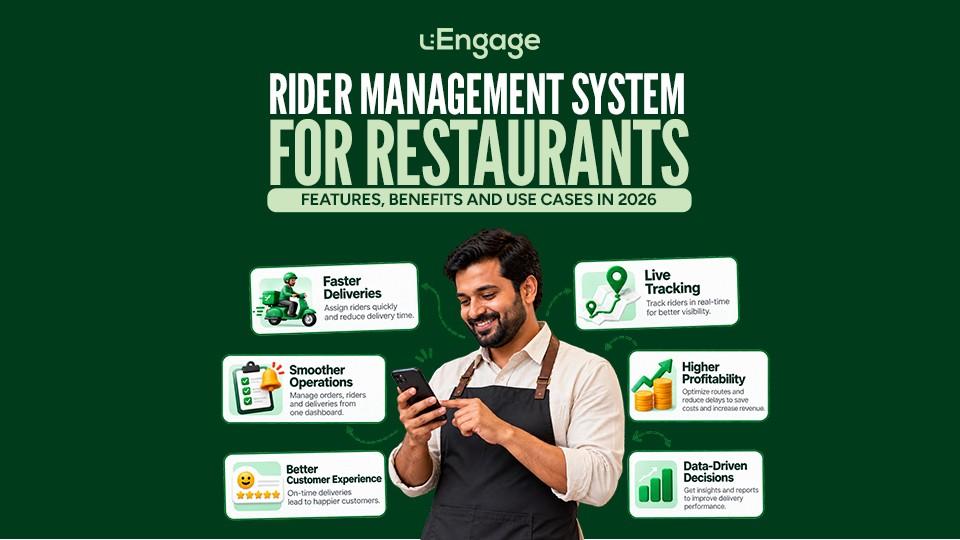
A rider management system for restaurants brings rider allocation, live tracking, route planning, third-party delivery partners and performance reporting into one connected workflow. It helps restaurants manage deliveries without losing visibility once an order leaves the kitchen.
A rider management system does not simply track riders. It connects every stage between “order ready” and “delivery completed.”
What Is a Rider Management System for Restaurants?
A rider management system is software that helps restaurants assign, track and manage delivery riders from a central dashboard.
It can support:
In-house delivery riders
Third-party delivery partners
Hybrid delivery fleets
Single and multi-outlet restaurants
On-demand and scheduled deliveries
Multi-brand cloud kitchens
When an order becomes ready for dispatch, the system checks rider availability, delivery location, distance and workload before assigning the order. Operations teams can then monitor its progress until delivery is completed.
For customers, this means better delivery visibility. For restaurant teams, it means fewer calls, less manual coordination and more control over delivery performance.
Why Restaurant Rider Management Matters in 2026
Restaurant delivery is no longer an additional sales channel. For many QSRs, cloud kitchens and delivery-first brands, it is a core part of the customer experience.
ONDC reports more than 100,000 active restaurants across its network, with an average delivery time of approximately 31 minutes, a 95–98% order fill rate and around 89% on-time delivery performance. These numbers show the operational standards restaurants must now prepare for as connected commerce and integrated logistics continue to grow in India. ondc.org
The challenge is that delivery operations become harder as brands add:
More outlets
Larger delivery zones
Multiple rider partners
Higher peak-hour order volumes
In-house and external fleets
Different POS and ordering channels
Without a connected system, the restaurant may receive the order digitally but still manage the delivery manually. That gap creates delays.
Common Rider Management Problems Restaurants Face
1. Rider assignment takes too long
If outlet teams have to call riders individually, every order spends additional time waiting before dispatch.
During peak hours, the team may not know:
Which rider is available
Which rider is closest
Who is already handling another order?
Whether a third-party partner should be requested
An automated allocation system reduces this decision time.
2. Restaurants cannot see what happens after pickup
Once the rider leaves the outlet, managers may lose visibility until the customer calls or the rider marks the order delivered.
Without live tracking, teams cannot easily identify:
Riders taking an unexpected route
Orders stuck at the outlet
Long pickup-to-delivery times
Incorrect delivery status
Customers likely to receive a delayed order
3. In-house and third-party fleets remain disconnected
Many restaurants use a hybrid delivery model. Their own riders serve nearby orders, while external partners handle overflow or distant locations.
If both fleets operate through separate dashboards, managers have to switch between systems and manually compare availability.
4. Delivery performance is difficult to measure
A restaurant might know that an order was delivered, but not:
How long rider assignment took
How long the rider waited at the outlet
Whether the order reached the customer within the SLA
Which outlets create the most dispatch delays
Which riders complete the most successful deliveries
Without these insights, the same problems repeat.
Essential Features of a Restaurant Rider Management System
1. Automatic rider allocation
Automatic allocation assigns an order according to predefined factors such as:
Rider availability
Distance from the outlet
Delivery zone
Current workload
Order priority
Delivery SLA
Vehicle or order requirements
The aim is not merely to find any rider. It is to assign the most suitable available rider without unnecessary manual coordination.
2. Manual rider assignment
Automation should not remove operational control.
Outlet managers may still need manual assignment for:
VIP or high-value orders
Scheduled deliveries
Large catering orders
Cash-on-delivery orders
Delivery exceptions
Specific service zones
A good system should support both automated and manual allocation.
3. Real-time rider tracking
Live tracking gives the restaurant a clear view of the rider’s location and the order’s current status.
uEngage’s delivery-tracking workflow, for example, supports automated rider assignment, customer tracking links, real-time location sharing and proof of delivery.
This visibility helps operations teams respond before a delay becomes a customer complaint.
4. Hybrid fleet management
Restaurants should be able to manage their own riders and third-party delivery partners from one system.
A hybrid fleet provides flexibility:
In-house riders can handle nearby, frequent deliveries
Third-party partners can manage overflow
External fleets can cover locations where the restaurant has no rider
Restaurants can switch based on cost, availability or SLA
This is especially useful for multi-outlet restaurant brands with different delivery demand at each location.
5. Rider app
A dedicated restaurant rider app should give riders the information needed to complete a delivery without repeated calls.
Important rider-app functions include:
Accepting assigned orders
Viewing pickup information
Accessing customer location
Starting navigation
Updating delivery status
Calling the customer or outlet
Collecting OTP confirmation
Uploading delivery proof
Reporting delivery issues
6. Route optimisation
Route optimisation helps restaurants plan efficient delivery paths based on distance, active orders and delivery locations.
For restaurants clubbing multiple nearby orders, routing becomes particularly important. A poorly planned sequence can make the first order wait while the rider completes a less urgent delivery.
7. Geofencing and automated status updates
Geofencing uses location boundaries to identify when a rider:
Reaches the restaurant
Leaves the pickup location
Enters the customer’s delivery area
Completes the trip
This reduces dependence on riders manually updating every status and gives the operations team more reliable delivery data.
8. Proof of delivery
Proof of delivery helps reduce disputes and verify that an order reached the correct customer.
Verification may include:
Customer OTP
Delivery photograph
Timestamp
Rider location
Customer signature
Payment confirmation
This is particularly useful for prepaid, high-value and cash-on-delivery orders.
9. Rider KYC and attendance
Restaurants operating their own fleet need a structured way to manage rider identity, attendance and availability.
A rider management platform may help maintain:
Rider profiles
KYC documents
Shift attendance
Login and logout records
Assigned outlet or service zone
Current availability
Completed delivery history
10. Delivery analytics
A central dashboard should help managers compare performance by rider, outlet, city and delivery partner.
Useful metrics include:
Average rider assignment time
Rider arrival time
Order-ready-to-pickup time
Average delivery time
On-time delivery percentage
First-attempt delivery success
Cost per delivery
Rider utilisation
Orders delivered per rider
Delivery cancellations
Customer complaints
Proof-of-delivery completion
Benefits of Rider Management Software for Restaurants
Faster dispatch
Automated allocation reduces the time spent searching for and contacting an available rider.
This matters because a late delivery may begin while the prepared order is still waiting at the outlet—not after the rider reaches the road.
Better rider utilisation
The restaurant can see which riders are active, available, occupied or offline. Orders can be distributed more evenly instead of overloading a few riders while others remain idle.
More reliable customer updates
Customers can receive tracking links and delivery-status updates through SMS or WhatsApp.
In broader online retail research, 75% of surveyed US consumers said they value delivery-status notifications. While restaurant delivery timelines are much shorter, the underlying expectation is similar: customers want accurate, timely visibility after placing an order.
Lower operational workload
A connected workflow reduces repeated calls between:
Outlet teams
Dispatch managers
Riders
Delivery partners
Customers
The team can focus on exceptions instead of manually coordinating every delivery.
Easier multi-outlet management
Central teams can identify which outlets experience the most delayed assignments, rider shortages or SLA failures.
This helps restaurant brands fix operational patterns instead of treating each delayed order as an isolated incident.
Better accountability
Timestamped status updates, rider movement and proof of delivery create a clearer operational record.
When an issue occurs, managers can identify whether the delay happened during:
Order preparation
Rider assignment
Rider arrival
Pickup
Transit
Customer handover
Restaurant Rider Management Use Cases
Use case 1: Multi-outlet QSR handling peak-hour demand
A QSR chain receives a high volume of lunch and dinner orders across multiple outlets.
Without a rider management system, each outlet assigns riders manually. Some outlets have idle riders, while others struggle to fulfil orders.
With a central system, the brand can:
Monitor rider availability by outlet
Auto-assign riders based on distance and workload
Request third-party riders during demand spikes
Track delivery SLAs across locations
Compare outlet performance
Business outcome: Faster dispatch and more balanced fleet utilisation.
Use case 2: Cloud kitchen managing multiple brands
A cloud kitchen operates several brands from one location. Each brand receives orders from different channels, but deliveries use the same rider pool.
A unified rider management system can:
Bring orders into one dispatch queue
Assign riders across brands
Prevent duplicate assignments
Club nearby orders when operationally suitable
Track brand-wise and outlet-wise delivery performance
Business outcome: One rider operation can support multiple brands without creating separate delivery workflows.
Use case 3: Restaurant using in-house and third-party riders
The restaurant prefers its own riders for nearby orders but uses external delivery partners during peak hours.
The system can first check the internal fleet and then request a third-party rider if:
No in-house rider is available
The customer is outside the preferred delivery zone
The internal fleet is overloaded
A delivery partner offers a better SLA
Business outcome: The restaurant maintains control while gaining flexible delivery capacity.
Use case 4: Franchise brand needing central visibility
Individual franchise outlets may manage local riders, while the head office needs brand-level delivery reporting.
A central dashboard can show:
Delivery volumes by outlet
SLA compliance
Rider productivity
Delayed orders
Delivery partner performance
Cancellation and failure patterns
Business outcome: Franchise teams retain local control while the brand gains consistent reporting.
Use case 5: Restaurant managing COD deliveries
Cash-on-delivery orders can create reconciliation challenges if payment and order statuses are not connected.
A rider management workflow can capture:
Payment mode
Collection status
Delivery confirmation
Rider responsible
Amount collected
Timestamp and proof
Business outcome: Fewer payment-status gaps and clearer rider accountability.
Use case 6: Delivery-first restaurant expanding into new cities
A growing brand may not want to build a full in-house fleet in every new market.
By connecting multiple delivery partners through one integration, the brand can expand while retaining:
Unified order status
Standard delivery workflows
Central tracking
Consistent reporting
Partner-level performance comparisons
Business outcome: Faster expansion without rebuilding the delivery stack for every city.
How to Choose the Right Rider Management System
Before selecting a platform, restaurant teams should ask:
Can it manage both in-house and third-party riders?
Does it integrate with our POS and ordering channels?
Can it automate rider allocation?
Does it support live tracking and customer tracking links?
Can we configure delivery zones and SLAs?
Does it provide OTP or photo-based delivery proof?
Can we compare rider, outlet and delivery-partner performance?
Does it support multi-outlet and multi-city operations?
Can managers override automated assignments?
How are rider KYC, attendance and availability handled?
Does it support COD or digital-payment confirmation?
Can the platform scale during peak order volumes?
A long feature list is not enough. The system must fit the restaurant’s actual ordering, dispatch and delivery workflow.
How uEngage Delivery Supports Restaurant Rider Management
uEngage Delivery, powered by Flash, brings restaurant delivery operations into one connected platform.
It supports:
Automatic and manual rider allocation
In-house and third-party fleet management
Real-time rider tracking
Customer tracking links
Route optimisation
Order clubbing
Rider KYC and attendance
Geofence-based status updates
OTP and photo proof of delivery
Fraud-prevention workflows
Central delivery analytics
POS and ordering integrations
Multi-outlet delivery management
The platform is designed as dispatch and tracking software; restaurants remain responsible for managing their fleet, rider safety, insurance and KYC compliance.
According to uEngage’s company-reported figures as of August 2026, its delivery infrastructure has managed more than 7 million deliveries, with 97% on-time deliveries and a reported 60% increase in fleet productivity across measured operations. These figures should be understood as platform-reported performance rather than guaranteed outcomes for every restaurant.
Better delivery performance does not come from adding riders blindly. It comes from knowing which rider should handle which order—and what happens next.
KPIs to Track After Implementation
To measure whether a rider management system is working, record a baseline before implementation and compare:
KPI | What it reveals |
|---|---|
Rider assignment time | How quickly an order receives a rider |
Order-ready-to-pickup time | Whether orders wait too long at the outlet |
Average delivery time | Overall delivery speed |
On-time delivery rate | Percentage of orders meeting the promised SLA |
Rider utilisation | How effectively the available fleet is being used |
Cost per delivery | Operational cost of fulfilling each order |
First-attempt success | Orders completed without reattempts |
Orders per rider | Rider productivity over a shift |
Delivery complaints | Customer-experience impact |
Proof-of-delivery rate | Compliance with verification processes |
Track these metrics separately by outlet and delivery partner. A strong overall average can hide a poorly performing location.
Final Takeaway
A rider management system helps restaurants move from reactive delivery coordination to structured, measurable operations.
It gives teams the tools to:
Assign riders faster
Manage hybrid fleets
Track every delivery
Reduce manual coordination
Improve customer visibility
Measure rider and outlet performance
Scale deliveries across locations
For a single restaurant, this can mean fewer calls and better order visibility. For a multi-outlet brand, it can become the operating layer connecting orders, outlets, riders and delivery partners.
Ready to bring every restaurant delivery into one connected workflow?