Let’s not pretend this is a “trend” anymore.
WhatsApp food ordering is quietly becoming the default direct ordering channel for restaurants in India.
But the real question is not what it is.
The real question is:
Should YOU actually use it?
Because if you get this wrong, you either:
-
Stay stuck paying commissions
-
Or adopt a half-baked setup that doesn’t scale
Let’s break it down properly.
Why Restaurants Are Even Considering WhatsApp Ordering
Short answer? Control.
Long answer? Money data repeat customers.
Most restaurants today operate like this:
-
Orders come from third-party apps
-
Customers don’t belong to them
-
Marketing starts from zero every month
According to industry estimates, restaurants lose 20–30% per order in commissions.
Now compare that with WhatsApp:
-
No middleman
-
Direct communication
-
Repeat orders become easier
That’s why more brands are shifting.
What is WhatsApp Food Ordering (And What It’s NOT)
Let’s clear confusion first.
WhatsApp food ordering is NOT:
Just replying manually on chat
Sending PDF menus
Taking orders on call and typing in POS
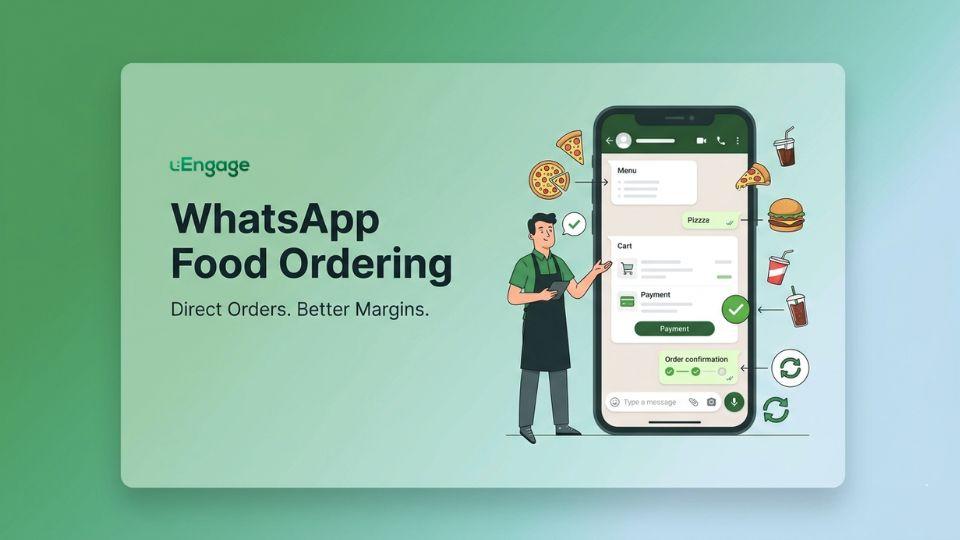
A proper system means:
-
Menu opens inside chat
-
Order gets placed instantly
-
Payment happens via link/UPI
-
Order goes to kitchen/POS
-
Customer data gets stored
In short: it’s a full ordering system inside WhatsApp
Should Restaurants Use WhatsApp Food Ordering?
Let’s answer this directly.
YES : if your goal is:
-
Increase direct orders
-
Reduce dependency on aggregators
-
Build repeat customers
-
Own your customer data
NO : if you:
-
Depend only on discovery traffic
-
Don’t have repeat customers yet
-
Don’t plan to run campaigns
Reality check:
Most serious brands today run hybrid model
(aggregators for discovery WhatsApp for retention)
Benefits of WhatsApp Food Ordering for Restaurants
1. Better Margins (No Heavy Commissions)
You’re not giving away 25% per order.
Simple math:
More direct orders = more profit per order
2. Higher Repeat Orders
WhatsApp is not just ordering.
It’s:
-
Campaign channel
-
Re-engagement tool
-
Customer retention engine
That’s where real growth happens
3. You Own Customer Data
No dependency. No guessing.
You know:
-
Who ordered
-
What they like
-
When to bring them back
4. Faster Ordering Experience
No app download
No login friction
Customer taps → orders → done
5. High Open Rates
WhatsApp messages have 80–90% open rates
Compare that with email… yeah, not even close.
Costs of WhatsApp Food Ordering in India
Let’s kill the biggest myth.
“WhatsApp ordering is free”
Not really.
Real costs include:
-
WhatsApp API charges
-
Platform subscription
-
Payment gateway fees
BUT…
Still cheaper than giving away 25% commission every order.
Common Mistakes Restaurants Make
This is where most fail.
Using WhatsApp manually
→ Doesn’t scale
No proper ordering flow
→ Customer drops off
No CRM or data tracking
→ No repeat business
WhatsApp alone is NOT the solution
System is.
What Actually Makes WhatsApp Ordering Work
Here’s the difference most people miss:
WhatsApp is just the channel.
The real power comes from the system behind it.
You need:
-
Structured ordering flow
-
Payment integration
-
Customer data capture
-
Campaign automation
-
Repeat order tracking
That’s where a proper Whatsapp ordering system for restaurants comes in
Real Use Case (How Restaurants Are Winning)
Brands using structured WhatsApp ordering systems are seeing:
-
Higher repeat customer rates
-
Lower customer acquisition costs
-
Better campaign ROI
As one restaurant operator put it:
“We didn’t need more customers.
We needed a way to bring them back.”
How to Set Up WhatsApp Food Ordering
Simple breakdown:
-
Choose a platform (not manual setup)
-
Upload your menu
-
Integrate payments
-
Connect POS / order flow
-
Start sharing WhatsApp link
-
Run campaigns
Final Verdict: Is It Worth It?
If you’re serious about:
-
Margins
-
Customer ownership
-
Long-term growth
Then YES.
If you just want more orders without control…
stick to aggregators.