Introduction: The Queue Isn't Just a Line. It's Lost Revenue.
It's 8:00 PM on a Friday.
The restaurant is full. Orders are coming in. The kitchen is moving fast.
But the billing counter tells a different story.
A family waits to place an order.
Someone changes their mind after seeing the long queue.
Another customer skips dessert because the cashier is rushing through orders.
The restaurant has customers.
What it's running out of is time.
This isn't a rare situation. It's the reality for many restaurants during lunch and dinner rushes.
For years, restaurants solved this problem by adding more staff or more billing counters. But today, rising labour costs, increasing customer expectations, and the growth of digital ordering have changed the equation.
The question is no longer:
"How can we serve more customers?"
It's:
"How can we make ordering faster, smoother, and more consistent without adding operational complexity?"
That's why more restaurants are investing in self-ordering kiosks.
Not because they want to replace people.
But because they want to remove friction from the ordering experience.
"Great restaurants don't lose customers because of their food. They lose them because of the experience before the first bite."
Why Restaurants Are Rethinking the Counter
The restaurant counter used to be the centre of every operation.
Today, it's often the biggest bottleneck.
Modern diners expect ordering to be as easy as shopping online or paying through UPI. They don't want to wait in long queues, repeat customisations multiple times, or miss promotions because the restaurant is busy.
At the same time, restaurant teams are managing:
Peak-hour rushes
Staff shortages
Larger menus
More customisations
Dine-in, takeaway, and online orders, all at once
That makes every second at the counter more valuable.
According to the National Restaurant Association, restaurants continue to invest in technology that improves operational efficiency and enhances the guest experience. Self-service ordering has become one of the key technologies helping brands manage growing customer expectations while reducing pressure on frontline staff.
Similarly, industry reports from Grand View Research project strong growth in the global self-service kiosk market as restaurants continue adopting digital ordering solutions to improve speed, convenience, and operational efficiency.
This shift isn't about following a trend.
It's about solving everyday business problems.
What Is a Self-Ordering Kiosk?
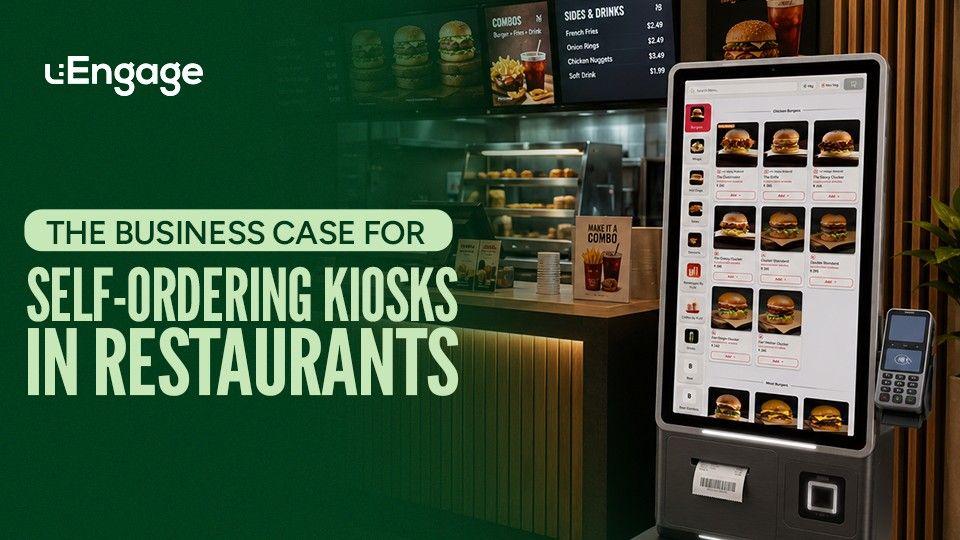
A self-ordering kiosk is a digital ordering station that allows customers to browse the menu, customise their meals, view offers, make payments, and place orders on their own.
Instead of waiting for someone to take the order, customers control the experience themselves.
A typical journey looks like this:
Start ordering
Choose dine-in or takeaway
Browse or search the menu
Customise items
Discover combos or add-ons
Review the cart
Continue as a guest or enter details
Select a payment method
Complete the order
The order is automatically sent to the connected POS or kitchen system for preparation.
For customers, it feels simple.
For restaurants, it creates a more organised and consistent ordering process.
Self-Ordering Kiosks Are More Than Digital Screens
One of the biggest misconceptions is that a kiosk is just a touchscreen replacing a cashier.
It isn't.
A modern restaurant kiosk connects the customer ordering experience with your menu, payments, promotions, and operational workflows. It can present relevant add-ons, highlight active offers, support dine-in and takeaway journeys, and integrate with the restaurant's existing systems.
In other words, it becomes another ordering channel, not another device sitting in the restaurant.
That's an important distinction.
Because successful restaurants don't invest in hardware.
They invest in better customer experiences.
The Real Business Problem Isn't the Queue
Most restaurant owners think queues are the problem.
They're actually a symptom.
The real problems are what queues create.
Customers Walk Away
Some customers simply don't want to wait.
If the line looks too long, they'll postpone the purchase, switch to another restaurant, or order online instead.
Every customer who leaves without ordering is revenue that never reaches the kitchen.
Staff Stay Busy With Repetitive Tasks
During rush hours, counter teams spend most of their time entering orders.
That leaves less time for greeting customers, answering questions, managing the dining area, or improving service.
A self-ordering kiosk doesn't remove the need for staff.
It removes repetitive order-taking, allowing teams to focus on preparation, fulfilment, queue assistance, and customer service.
Upselling Becomes Inconsistent
Imagine it's lunchtime.
The cashier is handling ten customers at once.
Will they remember to suggest fries, a beverage upgrade, or dessert every single time?
Probably not.
That's not a training issue.
It's human nature under pressure.
A kiosk presents relevant add-ons and combo suggestions consistently during the ordering journey, giving every customer the same opportunity to discover more items.
Notice the difference.
It doesn't guarantee higher order values.
It creates consistent upselling opportunities, which is a far more realistic and trustworthy expectation.
Promotions Often Go Unnoticed
Restaurants invest significant effort in creating meal deals, seasonal offers, and promotional campaigns.
Yet many customers never discover them.
Why?
Because staff may not mention every offer, especially during busy periods.
A kiosk can display active promotions as part of the ordering experience, making it easier for customers to see and redeem relevant offers without relying on verbal communication.
The Shift From Manual Ordering to Assisted Ordering
Restaurants sometimes worry that introducing a kiosk means replacing the human touch.
The reality is very different.
The most successful implementations use kiosks as an additional ordering channel.
Customers who prefer speaking with staff can still do so.
Customers who want speed and convenience can order independently.
This hybrid approach helps restaurants handle higher footfall without dramatically changing how they operate.
"Technology works best when it supports your team, not when it tries to replace it."
Excellent. In Part 1, we established why restaurants are rethinking the counter. Now, in Part 2, we answer the question every restaurant owner has:
"What will a self-ordering kiosk actually do for my business?"
This section focuses on business outcomes, not features, while naturally incorporating your uKiosk positioning.
The Business Case for Self-Ordering Kiosks in Restaurants
A restaurant owner rarely buys technology because it looks modern.
They invest in technology because it solves a business problem.
A self-ordering kiosk isn't valuable because it has a touchscreen.
It's valuable because it helps restaurants serve customers more efficiently, create a better ordering experience, and support day-to-day operations without making them more complicated.
Let's look at where that value comes from.
1. Turn Peak Hours Into Opportunity, Not Chaos
Every restaurant has rush hours.
Lunch breaks.
Weekend evenings.
Festivals.
Movie intervals.
Office closing hours.
During these periods, demand increases almost instantly, but the number of billing counters usually doesn't.
That creates queues.
Long queues don't just slow operations.
They affect the customer experience before the meal even begins.
Some customers wait.
Some leave.
Some order quickly just to avoid holding up the line.
A self-ordering kiosk adds another ordering channel, allowing customers to place their own orders while the counter continues serving others. This helps restaurants handle higher demand without disrupting existing operations.
Instead of thinking about it as "one more machine," think about it as one more place where customers can start their ordering journey.
"The busiest hour of the day shouldn't become the weakest part of your customer experience."
2. Consistent Upselling, Every Time
Imagine asking every cashier to remember the following for every order:
Suggest fries.
Recommend a beverage upgrade.
Offer a dessert.
Mention today's combo.
Highlight a limited-time promotion.
Now imagine doing that during the dinner rush.
It's difficult.
Not because your staff isn't capable.
Because they're human.
A self-ordering kiosk follows the same ordering flow every time.
It can consistently present relevant add-ons, combos, and upgrades during the customer's journey instead of relying entirely on manual prompts.
This creates a more consistent experience across orders.
It's important to understand what this means.
A kiosk doesn't guarantee higher average order values.
Menu design, pricing, customer preferences, and execution all play a role.
What it does provide is a consistent opportunity for every customer to discover additional items they may have otherwise missed.
That's a much stronger long-term business advantage.
3. Better Visibility for Offers You've Already Created
Restaurants spend time planning offers.
Weekend combos.
Festive meals.
Student discounts.
Limited-time launches.
But if customers don't notice them, the campaign loses much of its impact.
At busy counters, staff may not always communicate every promotion.
Customers often don't know which offers are available until after they've placed an order.
A self-ordering kiosk changes that.
Offers can be displayed directly within the ordering journey, making promotions easier to discover and redeem.
Instead of relying on verbal communication, the experience becomes visual and consistent.
That's especially valuable for restaurants running regular marketing campaigns or seasonal promotions.
4. Give Customers More Control Over Their Order
Restaurant menus have evolved.
Customers today expect to customise their meals.
Extra cheese.
No onions.
Less spicy.
Double toppings.
Takeaway instead of dine-in.
Traditional ordering often depends on verbal communication.
The more complex the order becomes, the greater the chance of misunderstanding.
A self-ordering kiosk allows customers to browse the menu, customise items, review their selections, and confirm everything before placing the order.
That gives customers more confidence in what they're ordering while reducing the need for repeated clarification.
When customers feel in control, ordering becomes faster, and often more enjoyable.
5. Support Different Restaurant Formats Without Changing the Experience
Not every restaurant operates the same way.
A quick-service restaurant has different operational needs than a café.
A food court differs from a multi-brand cloud kitchen.
Some businesses serve dine-in only.
Others handle takeaway, dine-in, and pickup simultaneously.
The right kiosk should adapt to your business, not force your business to adapt to it.
Modern kiosk platforms support multiple order types, including dine-in, takeaway, and outlet-specific workflows. Restaurants can also configure payment methods, guest checkout options, and store-level settings based on operational requirements.
That flexibility makes kiosks suitable for a wide range of restaurant formats rather than just large QSR chains.
6. A Better Experience for Multi-Brand Restaurants
Multi-brand restaurants face a different challenge.
Customers often need to choose between several brands before they even begin ordering.
Without a clear digital experience, that process can feel confusing.
A kiosk designed for multi-brand operations allows customers to browse different restaurant brands, menus, and experiences through a single ordering point while supporting centralised management behind the scenes.
For food courts, hospitality spaces, and shared kitchens, this creates a simpler experience for both customers and operations teams.
7. Staff Can Focus on Hospitality Instead of Repetitive Tasks
One of the biggest misconceptions about self-ordering kiosks is that they're meant to replace restaurant staff.
They're not.
The goal is to reduce repetitive order-taking so staff can spend more time where they create the most value:
Assisting guests.
Preparing orders.
Managing fulfilment.
Keeping queues moving.
Delivering better service.
This is exactly how successful restaurants use self-ordering technology, as an additional ordering option, not as a replacement for human interaction.
Technology handles routine tasks.
People handle relationships.
That's how the best customer experiences are built.
"Great hospitality isn't about taking orders faster. It's about spending more time with the people who matter."
8. More Than Hardware, A Platform That Fits Your Business
When people hear the word "kiosk," they often imagine a fixed machine with limited functionality.
Modern restaurant kiosks are much more than that.
They can be configured to reflect your brand, menu, payment preferences, promotions, checkout journey, and operational workflows. Settings don't have to remain identical across every outlet; they can be managed at the merchant, brand, store, or even device level.
This means a growing restaurant chain doesn't need separate systems for every location.
Instead, it gains a platform that can evolve alongside the business.
The Real Return on Investment
The value of a self-ordering kiosk shouldn't be measured by the screen itself.
It should be measured by the business outcomes it helps create.
Instead of asking:
"How much does a kiosk cost?"
Restaurant owners should ask:
Will customers order more smoothly during peak hours?
Can my team spend more time serving guests?
Will promotions become more visible?
Can ordering become more consistent across outlets?
Will the experience reflect my brand?
If the answer to those questions is yes, then the conversation moves beyond hardware.
It becomes a conversation about building a more efficient restaurant.
Are Self-Ordering Kiosks Worth It? Questions Every Restaurant Owner Should Ask
By now, one thing is clear.
A self-ordering kiosk isn't simply another screen inside a restaurant.
It's another way for customers to discover your menu, place orders, and interact with your brand.
But before making any investment, restaurant owners usually ask the same question:
"Is a self-ordering kiosk actually worth it for my business?"
The honest answer is...
It depends on how your restaurant operates.
If customers rarely wait, your menu is small, and your ordering process already runs smoothly, a kiosk may not be an immediate priority.
But if you're regularly dealing with queues, repetitive order taking, multiple brands, or growing customer traffic, the business case becomes much stronger.
Let's look at who benefits the most.
Which Restaurants Benefit the Most from a Self-Ordering Kiosk?
Not every restaurant has the same operational challenges.
That's why the best kiosk solution is one that adapts to different restaurant formats, not the other way around.
Quick Service Restaurants (QSRs)
QSRs serve hundreds of customers during peak hours.
Speed is critical.
Customers expect ordering to be quick, simple, and accurate.
A self-ordering kiosk provides another ordering point, helping restaurants manage rush-hour demand while maintaining a consistent ordering experience.
For burger chains, pizza brands, fried chicken outlets, sandwich stores, and similar formats, kiosks naturally fit into the customer journey.
Cafés and Bakeries
Walk into any busy café during the morning rush.
Some customers know exactly what they want.
Others are still deciding.
A kiosk allows customers to browse the menu at their own pace without feeling rushed.
They can explore beverages, desserts, seasonal specials, and add-ons before placing the order.
That creates a calmer and more enjoyable ordering experience.
Food Courts
Food courts face a unique challenge.
High footfall.
Limited ordering space.
Customers often compare multiple brands before deciding.
A kiosk designed for multi-brand operations can present different brands and menus through a single ordering point, making discovery simpler for customers while keeping operations organised.
Multi-Brand Restaurants and Cloud Kitchens
Restaurants managing multiple brands often struggle with fragmented ordering experiences.
Instead of directing customers to different counters or separate ordering systems, one kiosk can be configured to present multiple brands while supporting different menus and operational requirements.
For growing restaurant groups, this creates a more unified customer experience.
Corporate Cafeterias and Campuses
Corporate dining spaces experience predictable peak periods.
Everyone wants to order within a short window.
Additional ordering channels help distribute customer flow while allowing staff to focus on preparation and fulfilment.
Common Myths About Self-Ordering Kiosks
Technology often creates misconceptions.
Let's address the most common ones.
Myth 1: "Self-ordering kiosks replace restaurant staff."
Reality:
They don't.
In fact, the goal isn't to reduce hospitality.
It's to reduce repetitive order-taking.
When customers place routine orders independently, staff can spend more time preparing food, assisting guests, and improving service quality. This positioning aligns with how uKiosk is intended to be used as an additional ordering channel rather than a replacement for employees.
"Technology should remove repetitive work, not human hospitality."
Myth 2: "My customers prefer ordering from people."
Reality:
Many customers still do.
And that's perfectly fine.
A kiosk doesn't replace your billing counter.
It complements it.
Customers who prefer interacting with staff can continue doing so.
Others who value speed and convenience have another option.
Restaurants don't have to choose one experience over the other.
They can offer both.
Myth 3: "We Already Have a Billing Counter."
That's true.
Most restaurants do.
But during busy periods, one counter can quickly become a bottleneck.
A kiosk doesn't duplicate your counter.
It increases your ordering capacity.
Think of it as opening another checkout lane during rush hour, without redesigning your restaurant.
Myth 4: "Only Large Restaurant Chains Need Kiosks."
Not anymore.
As digital payments, QR ordering, and self-service become more common, kiosks are becoming accessible to restaurants of different sizes.
The right solution depends less on the number of outlets and more on operational requirements.
If your restaurant regularly experiences queues, handles large menus, or runs frequent promotions, a kiosk can add value regardless of brand size.
Myth 5: "Customers Won't Know How to Use It."
Today's customers are already comfortable using digital interfaces.
They order groceries through apps.
Book cabs.
Pay with UPI.
Browse digital menus.
A well-designed kiosk follows the same familiar behaviour.
Browse.
Select.
Customise.
Pay.
Order.
For customers using it for the first time, restaurant staff can assist during the initial adoption period until it becomes part of the normal dining experience.
How to Choose the Right Self-Ordering Kiosk
Not every kiosk platform offers the same flexibility.
Before making a decision, restaurant owners should look beyond the hardware and ask these questions.
Can It Work With My Existing POS?
A kiosk shouldn't create another disconnected system.
It should fit into your existing operations and route orders to the connected POS, kitchen, or fulfilment system.
Can It Match My Restaurant's Brand?
Customers shouldn't feel like they're ordering through someone else's platform.
Look for a kiosk that supports:
Brand colours
Logo
Promotional banners
Menu images
Landing screens
A branded experience builds familiarity and trust while keeping your digital and in-store identity consistent.
Can It Support Different Store Requirements?
As restaurants grow, no two outlets operate exactly the same way.
One location may require guest checkout.
Another may need table mapping.
Some stores may only support takeaway.
Others may offer dine-in, takeaway, and delivery.
Choose a kiosk platform that allows configurations at the merchant, brand, store, and device level instead of forcing every outlet to follow the same setup.
Can It Grow With My Business?
Technology shouldn't become obsolete after one year.
Your kiosk should support future changes such as:
New outlets
New payment methods
Seasonal promotions
Menu updates
Additional brands
Growth should feel like configuration, not redevelopment.
Technology Should Adapt to Restaurants, Not the Other Way Around
Every restaurant is different.
Different menus.
Different workflows.
Different customers.
That's why modern kiosk platforms are designed to be configurable instead of one-size-fits-all.
Whether it's payment methods, checkout preferences, order types, branding, operating hours, or promotions, restaurants should be able to configure the experience according to how they actually operate, not rebuild their operations around the technology.
That flexibility is what separates a long-term restaurant platform from a simple ordering screen.
"The best restaurant technology doesn't change how your restaurant works. It adapts to how your restaurant already works."
Why Modern Restaurants Are Choosing Configurable Kiosk Platforms
As restaurants grow, one thing becomes clear:
No two outlets operate exactly the same way.
A busy QSR in a shopping mall has different operational needs than a café inside a corporate office.
A food court serves customers differently from a premium dine-in restaurant.
A multi-brand cloud kitchen works differently from a single-outlet bakery.
Yet many kiosk solutions expect every restaurant to follow the same journey.
That's where restaurants often run into limitations.
The right kiosk platform shouldn't ask your business to change.
It should adapt to your business.
Beyond Ordering: What Restaurants Should Expect From a Modern Kiosk
When evaluating a self-ordering kiosk, restaurants should look beyond the screen itself.
The real value lies in how well the kiosk supports everyday operations.
A modern kiosk platform should help restaurants:
Offer dine-in and takeaway journeys.
Display relevant offers during ordering.
Support multiple payment methods.
Reflect the restaurant's own branding.
Adapt to different outlet requirements.
Connect with existing restaurant systems.
These aren't "extra" features.
They're part of creating a smooth experience for both customers and staff.
A restaurant's technology should feel like an extension of its operations, not a separate system that requires additional effort to manage.
Why Configuration Matters More Than Custom Development
One of the biggest challenges restaurant chains face is maintaining consistency while allowing individual outlets to operate differently.
One outlet may need:
Guest checkout.
Another may require:
Mobile number collection.
One restaurant may support:
Table service.
Another may operate entirely through takeaway.
Modern kiosk platforms should allow these requirements to be configured without rebuilding the product every time.
uKiosk follows this approach by allowing supported settings to be configured at different levels, including merchant, brand, store, and even individual kiosk devices, so restaurants can adapt the experience to operational needs.
That means growth becomes easier to manage.
Not harder.
A Restaurant Experience That Feels Like Your Brand
Customers shouldn't feel like they're ordering from a generic machine.
The ordering experience should reflect the restaurant they've chosen.
From brand colours and logos to menu images, promotional banners, and seasonal campaigns, modern kiosks should help restaurants maintain a consistent identity across both physical and digital touchpoints.
Because branding doesn't stop at the menu board.
It continues throughout the entire customer journey.
"Every interaction shapes your brand, including the way customers place an order."
The Future of Restaurant Ordering Is Hybrid
One of the biggest misconceptions about restaurant technology is that it replaces traditional service.
The reality is much more practical.
The future isn't:
Cashier or kiosk.
It's:
Cashier and kiosk.
Customers want choice.
Some prefer interacting with staff.
Others value speed and independence.
Restaurants that offer both experiences are better equipped to serve different customer preferences without compromising service quality.
Technology should expand customer choice, not reduce it.
Why Restaurants Are Investing Now
Restaurant technology has evolved significantly over the last few years.
Digital payments.
QR ordering.
Online delivery.
Loyalty programmes.
Customer data.
Today, self-ordering kiosks are becoming another important part of that digital ecosystem.
Not because restaurants want to automate everything.
But because they want to build operations that are more scalable, more consistent, and better prepared for future growth.
Restaurants that invest thoughtfully today are often the ones best positioned to handle tomorrow's customer expectations.
Final Thoughts
A self-ordering kiosk isn't just another piece of restaurant technology.
It's another way to serve customers.
When implemented thoughtfully, it helps restaurants create smoother ordering journeys, improve operational consistency, and support teams during their busiest hours.
The real business case isn't about replacing people.
It's about removing friction.
Customers spend less time waiting.
Staff spend less time repeating routine tasks.
Restaurants gain a more consistent way to present menus, offers, and ordering experiences.
As customer expectations continue to evolve, restaurants that combine great hospitality with smart technology will be better prepared for the future.
Because in the end, people don't remember how they placed the order.
They remember how easy the experience felt.
Key Takeaways
? A self-ordering kiosk is an additional ordering channel, not a replacement for restaurant staff.
? Restaurants benefit most when kiosks solve operational challenges like queues, repetitive order-taking, and inconsistent promotion visibility.
? Modern kiosks should support branding, flexible configurations, multiple payment methods, and integration with existing restaurant systems.
? The right kiosk platform adapts to different restaurant formats instead of forcing a one-size-fits-all approach.
? The future of restaurant ordering is a hybrid model where technology supports people and creates better guest experiences.