“Restaurants don’t struggle with demand anymore. They struggle with managing deliveries at scale.”
The Indian restaurant industry has evolved rapidly over the last few years.
Cloud kitchens, QSR chains, and multi-location brands are expanding faster than ever, driven by high delivery adoption and digital ordering.
But in 2026, growth has exposed a new challenge, delivery complexity.
Orders come from multiple channels.
Riders operate across locations.
Third-party logistics partners vary by city.
And customers expect fast, transparent deliveries every single time.
This is exactly why forward-looking brands are now investing in a delivery management platform instead of relying on fragmented, manual systems.
The Growing Delivery Problem Restaurants Can’t Ignore
At a small scale, restaurants manage deliveries with basic tools and manual coordination.
But once a brand operates:
-
Multiple outlets
-
Shared rider fleets
-
High daily order volumes
-
Multiple delivery partners
delivery starts becoming chaotic.
Common problems restaurants face include:
-
Manual rider assignment
-
No centralized visibility
-
Missed delivery SLAs
-
Inconsistent customer experience
-
Too many tools, too little control
Industry insight:
-
Last-mile delivery accounts for 50% of total delivery costs
-
Delivery delays reduce repeat orders by 30%
-
Multi-location brands receive 3× more delivery-related complaints
Without the right system in place, delivery chaos grows faster than revenue.
Why Traditional Delivery Setups Break at Scale
Most restaurants still manage delivery using:
-
Phone calls and WhatsApp groups
-
Separate systems per outlet
-
Individual dashboards for each partner
-
Manual tracking and follow-ups
This approach creates:
-
Operational overload
-
Poor rider utilization
-
Zero real-time insights
-
Stress during peak hours
As one operations manager shared:
“Our food quality was consistent, but our delivery experience wasn’t.”
This is where the shift to a unified system becomes essential.
What Is a Delivery Management Platform?
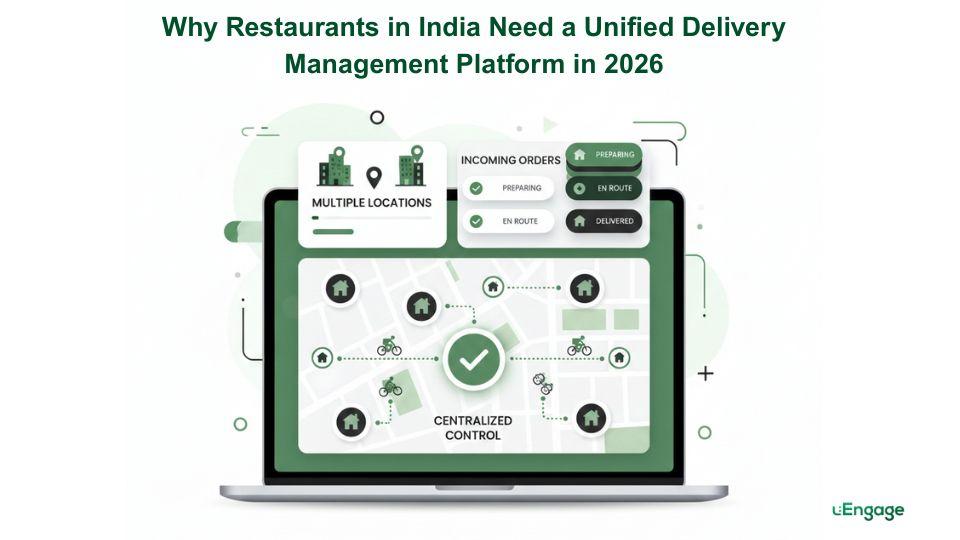
A delivery management platform is a centralized system that helps restaurants manage end-to-end delivery operations across outlets, riders, and logistics partners.
Instead of juggling multiple tools, restaurants get:
-
A single dashboard for all deliveries
-
Automated rider assignment
-
Route optimization
-
Live order tracking
-
3PL partner integration
-
Performance analytics
In simple terms, a delivery management platform gives restaurants visibility, automation, and control, all in one place.
Why Restaurants in India Are Adopting Unified Delivery Platforms in 2026
In 2026, restaurant brands are no longer experimenting with delivery tools.
They are standardizing operations.
Here’s why.
1. Centralized Control Across All Locations
Multi-location brands struggle when each outlet manages delivery independently.
A unified platform allows:
-
Central monitoring of all orders
-
Balanced rider allocation
-
Consistent delivery standards across cities
This centralized control is one of the biggest advantages of using a delivery management platform.
2. Automated Rider Assignment (No More Manual Dispatch)
Manual rider assignment doesn’t scale.
Modern systems auto-assign riders based on:
-
Distance
-
Availability
-
Current workload
Restaurants using automated dispatch report:
-
25–35% fewer delivery delays
-
Improved rider productivity
-
Reduced dependency on staff coordination
Automation removes guesswork and speeds up dispatch.
3. Route Optimization for Faster Deliveries
Indian cities are unpredictable, traffic, weather, and peak hours can disrupt delivery timelines.
Route optimization helps restaurants:
-
Avoid traffic-heavy routes
-
Reduce fuel costs
-
Improve delivery ETAs
Optimized routing improves delivery efficiency by 20–25%, especially in metro cities.
4. Live Delivery Tracking for Customers & Teams
Customers expect transparency.
Live tracking:
-
Reduces “Where is my order?” calls
-
Improves customer trust
-
Enhances post-order experience
Brands using live tracking see 30% reduction in delivery-related support queries.
For operations teams, tracking brings accountability and visibility.
5. Seamless 3PL & Last-Mile Integration
As brands scale, they often work with:
-
In-house fleets
-
Hyperlocal delivery partners
-
City-specific 3PLs
A unified delivery management platform brings all partners into one system, ensuring:
-
Consistent tracking
-
Standardized updates
-
Unified performance reporting
This eliminates fragmentation and confusion.
Why Delivery Experience Now Defines the Brand
In 2026, customers judge restaurants not just by food quality, but by delivery experience.
Late deliveries.
Poor communication.
No tracking.
These issues directly impact:
-
Customer satisfaction
-
Online reviews
-
Repeat orders
“Great food wins the first order.
Great delivery wins the second.”
Delivery is no longer just fulfillment, it’s brand experience at scale.
How a Unified Delivery Platform Drives Business Growth
Restaurants using structured delivery systems report:
-
Higher on-time delivery rates
-
Lower operational stress
-
Better customer satisfaction
-
More repeat orders
By replacing chaos with clarity, a delivery management platform becomes a growth enabler, not just an ops tool.
How uEngage Flash Supports Modern Restaurant Delivery
uEngage Flash is built specifically for the complexities of restaurant delivery in India.
It helps brands:
-
Centralize delivery operations
-
Automate rider assignment
-
Optimize delivery routes
-
Track orders in real time
-
Integrate multiple 3PL partners
-
Monitor delivery performance across outlets
For growing restaurant brands, Flash acts as a unified delivery command center.
This allows teams to focus on scaling the business, not firefighting delivery issues.
The New Standard for Restaurants in 2026
In 2026, successful restaurants are not:
-
Making more calls
-
Adding more manual steps
-
Switching between multiple tools
They are:
-
Centralizing delivery workflows
-
Automating dispatch
-
Using data to improve operations
A delivery management platform is no longer optional, it’s the foundation of scalable restaurant delivery.
Final Takeaway
Restaurant delivery is only getting more complex.
Brands that continue to manage deliveries manually will struggle with:
-
Delays
-
Inconsistency
-
Customer churn
Those that invest in a unified delivery management platform will:
-
Scale faster
-
Deliver consistently
-
Build stronger customer trust
In 2026, delivery excellence is not a differentiator, it’s a requirement.