
“Customers don’t want to download another app.They want to place an order where they already are.”
In 2026, the restaurant ordering battle in India is no longer about websites vs apps.
It’s about convenience vs friction.
And the platform winning this battle is not new.
It’s already on your customer’s phone.
WhatsApp.
With over 500 million active users in India, WhatsApp has quietly become the most powerful ordering channel for restaurants. This is exactly why a WhatsApp ordering system for restaurants is no longer an experiment, it’s a serious growth channel.
Why Restaurant Ordering Is Shifting to WhatsApp
Indian consumers have changed the way they interact with brands.
They don’t want:
-
Long sign-ups
-
App downloads
-
Complex checkout flows
They want:
-
Fast replies
-
Simple menus
-
Familiar interfaces
Key Stats (India-specific):
-
WhatsApp messages have 90% open rates
-
Chat-based orders convert 2–3× higher than app installs
-
Over 70% of Indian customers prefer messaging over calling a business
-
Restaurants using chat-based ordering see 20–30% higher repeat orders
This shift is why a WhatsApp ordering system for restaurants is becoming a core part of modern ordering stacks in India.
What Is a WhatsApp Ordering System for Restaurants?
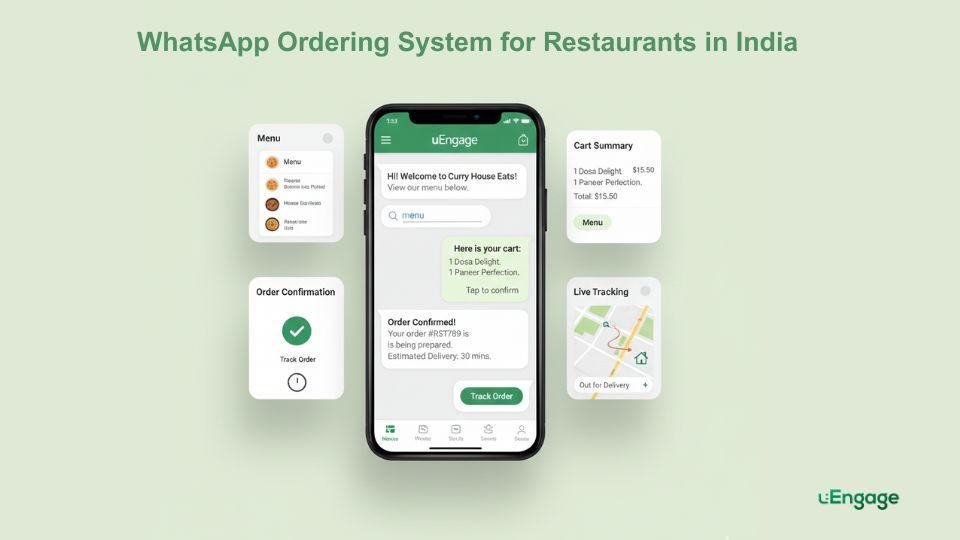
A WhatsApp ordering system allows customers to:
-
Browse menus on WhatsApp
-
Place orders via chat
-
Receive payment links
-
Get order confirmations
-
Track delivery updates
All without leaving WhatsApp.
From a restaurant’s perspective, it becomes a direct ordering channel that:
-
Reduces friction
-
Improves response time
-
Increases order completion
Instead of pushing customers to new platforms, restaurants meet them where they already are.
Why 2026 Belongs to Chat-Based Ordering
Chat-based ordering isn’t a trend, it’s a behavioural shift.
Here’s why 2026 is the tipping point.
1. Zero App Fatigue = Higher Conversions
Indian users are tired of downloading apps for every brand.
A WhatsApp ordering system removes:
-
App installs
-
Login barriers
-
Password fatigue
Customers simply send a message and place an order.
“The best ordering experience is the one customers don’t have to learn.”
This simplicity directly improves conversion rates.
2.Faster Ordering During Peak Hours
During rush hours, speed matters more than features.
WhatsApp ordering enables:
-
Quick reorders
-
Saved preferences
-
Instant confirmations
Restaurants using WhatsApp ordering report faster order completion times, especially during lunch and dinner peaks.
This is one of the biggest reasons brands are investing in a WhatsApp ordering system for restaurants.
3. Perfect Fit for India’s Behaviour
India is a chat-first market.
Customers already use WhatsApp to:
-
Ask questions
-
Check availability
-
Confirm timings
Turning those conversations into orders is a natural next step.
Real example:
Many QSRs and cafés in India noticed that customers were already DM-ing on WhatsApp. Adding structured ordering simply formalised what was already happening.
WhatsApp Ordering vs Website & App Ordering
This is not about replacing websites or apps.
It’s about complementing them.
| Channel | Best Use Case |
|---|---|
| Website Ordering | Discovery, SEO traffic |
| Mobile App | Loyal, repeat customers |
| WhatsApp Ordering | Quick orders, reorders, high conversions |
In 2026, winning restaurants use a hybrid ordering model, where WhatsApp acts as the fastest conversion channel.
What Makes a Good WhatsApp Ordering System in India
Not every WhatsApp setup works.
Successful restaurants focus on these essentials:
Structured Menus (Not Free-Text Chaos)
Manual WhatsApp ordering fails when:
-
Menus are shared as PDFs
-
Orders are typed manually
-
Staff misreads items
A proper WhatsApp ordering system for restaurants uses:
-
Menu buttons
-
Item selection flows
-
Automated confirmations
This keeps operations clean and scalable.
Integrated Payments
Indian customers expect:
-
UPI
-
Cards
-
Wallets
Sending instant payment links inside WhatsApp reduces drop-offs and speeds up checkout.
Automated Updates & Notifications
Customers want updates without asking.
Automation enables:
-
Order confirmation messages
-
Preparation updates
-
Dispatch notifications
-
Delivery completion alerts
Restaurants using automated WhatsApp updates see 30% fewer “order status” queries.
Reorder & Retention Flows
This is where WhatsApp really shines.
Restaurants can:
-
Send reorder nudges
-
Share personalised offers
-
Trigger win-back messages
This turns WhatsApp from an ordering channel into a retention engine.
Real Use Cases: How Restaurants Are Using WhatsApp Ordering
Cafés & QSRs
-
Quick takeaway orders
-
Office lunch bulk ordering
-
Repeat customer reorders
Cloud Kitchens
-
Direct ordering without aggregator dependency
-
Late-night order handling
-
High-frequency customers
Multi-Location Brands
-
Centralised WhatsApp number
-
Location-based routing
-
Consistent ordering experience across outlets
These use cases explain why WhatsApp ordering adoption is accelerating across India.
Why WhatsApp Ordering Improves Repeat Orders
Repeat orders don’t happen because of discounts.
They happen because of ease.
WhatsApp provides:
-
Familiar interface
-
No learning curve
-
Instant access
Brands using chat-based ordering report:
-
20–40% increase in repeat orders
-
Higher customer lifetime value
-
Lower marketing cost per order
This is why a WhatsApp ordering system for restaurants plays a key role in retention strategies.
How uEngage Edge Enables WhatsApp Ordering at Scale
uEngage Edge offers a structured WhatsApp ordering experience designed specifically for restaurants.
With Edge, restaurants can:
-
Set up WhatsApp ordering without chaos
-
Sync menus with website & app
-
Automate order confirmations and updates
-
Accept payments inside WhatsApp
-
Route orders correctly across outlets
This ensures WhatsApp ordering remains scalable, not manual.
For growing brands, Edge turns WhatsApp into a high-conversion ordering channel instead of an operational headache.
The Bigger Picture: Ordering in 2026
In 2026, restaurant growth is not about adding more channels.
It’s about reducing friction across channels.
WhatsApp ordering fits perfectly into this future because:
-
It aligns with user behaviour
-
It improves speed
-
It increases conversions
-
It strengthens retention
“The future of ordering is not louder marketing —
it’s quieter, simpler experiences.”
Final Takeaway
In India, the future of restaurant ordering is conversational.
A WhatsApp ordering system for restaurants is no longer optional in 2026, it’s a competitive advantage.
Restaurants that adopt it early will:
-
Convert faster
-
Retain better
-
Reduce dependency on aggregators
-
Build stronger customer relationships