
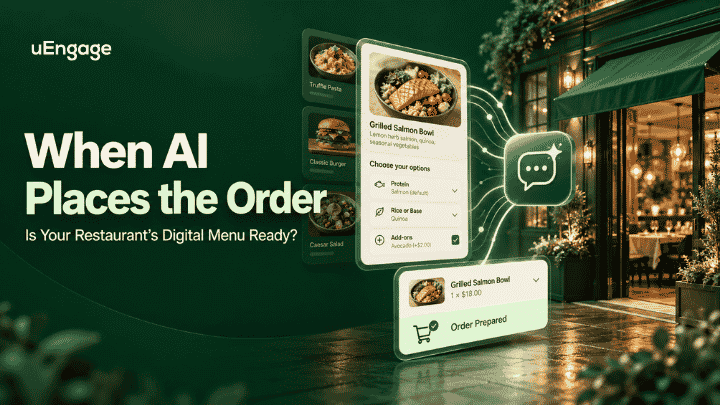
A customer opens an AI assistant and says:
“Order a vegetarian dinner for two from a well-rated restaurant near me. Keep it under 800 and avoid anything too spicy.”
Until recently, an AI tool could only suggest a few restaurants and leave the customer to complete the journey.
That is beginning to change.
AI assistants are moving from answering questions to performing actions. They can understand requirements, compare available options, build a cart and, where supported, initiate checkout.
For restaurants, this introduces a completely new type of customer:
The customer may still decide what to eat, but an AI agent may decide which menu to read, which options to compare and how the order is placed.
The question is no longer limited to whether customers can find your restaurant online.
Can an AI system understand your menu well enough to order from it?
Can AI Really Order Food for Customers?
Yes, the technology required for AI-assisted ordering is already emerging.
An AI ordering agent is a software system that can interpret a customer’s request, evaluate available options and complete multiple steps toward placing an order.
Depending on the platform and available integrations, it may:
Search for suitable restaurants
Compare menus, prices and ratings
Apply dietary or budget preferences
Select dishes and customisations
Build an order
Confirm delivery information
Initiate or complete checkout
Share order and delivery updates
OpenAI’s Agentic Commerce Protocol, for example, is designed as a connection between merchants and AI users. Its checkout framework allows merchants to support AI-led purchases while retaining their existing order, payment and compliance systems.
DoorDash has also introduced conversational restaurant discovery and ordering experiences, including AI-assisted search and integrations that allow workplace AI tools to initiate group food orders.
The direction is becoming clear:
AI is moving from recommending where customers could order to helping them complete the order.
What Is Agentic Food Ordering?
Agentic food ordering is an ordering experience in which an AI system performs tasks on behalf of a customer instead of only providing information.
A conventional chatbot responds to a question.
An AI ordering agent can interpret the request, make decisions within the customer’s instructions and take the next permitted action.
For example:
Traditional search
“Best pizza near me”
The customer receives links, opens different listings, compares menus and places the order manually.
Conversational search
“Suggest a good pizza place near me with vegetarian options under 600.”
The AI provides a short list based on the available information.
Agentic ordering
“Order my usual vegetarian pizza from a nearby restaurant and deliver it before 8 PM.”
The AI may identify the restaurant, locate the relevant item, confirm the price, prepare the cart and move the customer toward checkout.
The interface changes, but the restaurant still needs to provide the information and infrastructure behind the experience.
Why the Digital Menu Becomes Critical
A human customer can often work around a confusing menu.
They may zoom into a PDF, call the outlet, ask whether an item is available or guess what an unclear description means.
An AI system cannot reliably fill these gaps without risking a wrong recommendation or order.
For an AI ordering agent, the menu is not just a visual sales asset. It is structured commercial data.
The agent needs to understand:
Item name
Category
Description
Price
Availability
Portion or serving information
Vegetarian or non-vegetarian classification
Ingredients and allergens
Customisation options
Add-ons
Outlet availability
Taxes and additional charges
Delivery eligibility
OpenAI’s commerce documentation similarly highlights the role of updated product feeds and attributes in helping AI systems correctly understand and surface products.
For restaurants, the equivalent foundation is an accurate, accessible and consistently maintained digital menu.
What Happens When the Menu Is Not AI-Ready?
Imagine that a customer asks an AI assistant:
“Find a gluten-free meal near Sector 29 that can be delivered within 40 minutes.”
Your restaurant may offer the perfect meal, but the AI may not confidently select it if:
Dietary information is missing
The item description is vague
The delivery location is unclear
The outlet timings are outdated
The item appears differently across platforms
Prices are inconsistent
Availability is not updated
The menu is available only as an image
The direct ordering link is broken or difficult to locate
The restaurant does not lose because the food is unsuitable.
It loses because its digital information does not clearly communicate that suitability.
This leads to an important rule for the next phase of restaurant discovery:
If an AI agent cannot understand the menu, it cannot confidently recommend or order from it.
AI Ordering Agent vs Restaurant Chatbot
These terms are often used interchangeably, but they represent different capabilities.
Restaurant chatbot | AI ordering agent |
|---|---|
Responds to customer questions | Interprets a customer’s complete intent |
Usually follows predefined flows | Can evaluate multiple options and steps |
Shares a menu or ordering link | May select items and prepare the order |
Requires the customer to drive each action | Can act within customer-approved instructions |
Primarily supports communication | Supports decision-making and transactions |
Often operates on one channel | May work across search, menu, checkout and delivery systems |
A chatbot may answer, “Yes, this restaurant delivers to your area.”
An agent may use that information to select an eligible outlet, prepare the order and initiate checkout.
The difference is not simply better conversation.
It is the ability to move from answering to acting.
Why This Matters for Restaurants in India
India is already a messaging-first market.
Meta reports that, according to a Kantar study, 91% of online adults in India chat with a business weekly. Meta has also introduced Business AI for small businesses on WhatsApp in India to handle customer questions and support sales conversations.
Messaging, conversational search and digital payments are increasingly becoming parts of the same customer journey.
That does not mean every restaurant will begin receiving fully autonomous AI orders immediately.
It means customer expectations are moving toward:
Asking instead of browsing
Describing instead of filtering
Conversing instead of navigating
Delegating instead of completing every step manually
Restaurants that maintain clear digital information will be better prepared as these behaviours become more common.
Seven Things an AI-Ready Restaurant Menu Needs
1. Clear item names
Avoid names that make sense only to someone already familiar with the restaurant.
“Chef’s Special 2” tells an AI agent very little.
“Paneer Tikka Rice Bowl” communicates the product immediately.
Creative menu names can remain, but they should be supported by clear descriptions.
2. Useful descriptions
A strong item description should explain:
What the item contains
How it is prepared
Whether it is spicy
The approximate portion
Relevant dietary information
This helps customers make decisions and gives search and AI systems meaningful context.
3. Accurate prices
Prices should remain consistent across the restaurant website, ordering system and other owned channels.
When the same item displays multiple prices without context, the system cannot easily determine which one is current.
4. Dietary and allergen information
Marking items as vegetarian, vegan, gluten-free or containing common allergens can help an AI system match the menu with a specific customer request.
Restaurants should only use labels that they can support operationally. AI readiness should improve accuracy, not create unsupported claims.
5. Proper modifiers and add-ons
Size, spice level, toppings, sides and add-ons should be structured as selectable options.
If every customisation exists only inside a long description, it becomes harder for both the customer and an ordering system to process correctly.
6. Outlet-level availability
A multi-outlet restaurant may not serve every item at every location.
The digital ordering system should show:
Correct outlet
Current menu
Service hours
Delivery availability
Item availability
Applicable pricing
An AI system needs to know not only what the restaurant serves, but whether the selected outlet can fulfil that order now.
7. A connected ordering journey
Discovery is useful only when the customer can take the next step.
A restaurant should provide a clear path from:
Menu discovery ? item selection ? customisation ? payment ? order confirmation ? delivery
Disconnected menus, broken links and outdated pages create friction for human customers and AI-driven journeys alike.
Does This Mean Restaurant Websites and Apps Will Disappear?
No.
The interface may change, but the restaurant’s digital infrastructure becomes more important.
An AI agent still needs a reliable source for:
Menu information
Prices
Outlet details
Availability
Customer choices
Payments
Order confirmation
Delivery status
A restaurant’s website, app and ordering system can provide this source of truth.
The future is unlikely to be “AI instead of restaurant websites.”
It is more likely to be:
AI as an additional interface connected to the restaurant’s digital ordering infrastructure.
How Restaurants Can Prepare for Agentic Ordering
Restaurants do not need to build an AI agent tomorrow.
They should first fix the digital foundation an AI-led experience would depend on.
Step 1: Audit the digital menu
Review item names, descriptions, categories, prices, dietary details, modifiers and availability.
Remove duplicate or outdated menu versions.
Step 2: Standardise outlet information
Keep outlet addresses, operating hours, menus, delivery zones and contact details consistent.
Step 3: Strengthen direct ordering
Ensure that customers can move from the website, Google listing, social channel or WhatsApp conversation to a clear ordering journey.
Step 4: Connect the operational systems
An order should not become a manual message that staff must interpret and re-enter.
Connect ordering with the relevant POS, payment and fulfilment workflows wherever supported.
Step 5: Maintain real-time accuracy
AI can only make reliable decisions using reliable information.
Menu availability, operating hours and outlet information should be treated as live business data—not one-time website content.
Step 6: Measure customer behaviour
Track which channels generate orders, which menu items customers select and where they abandon the journey.
AI readiness without measurement is still guesswork.
Where uEngage Fits
uEngage helps restaurant brands build the digital ordering foundation required for current and emerging customer journeys.
Restaurants can use uEngage to support:
Branded online ordering
Give customers a direct ordering experience through the restaurant’s own website and app.
Digital menu management
Maintain menu items, categories, prices, modifiers and outlet-level information within a connected ordering experience.
WhatsApp ordering
Allow customers to begin or continue the ordering journey on a familiar conversational channel.
Multi-outlet ordering
Help customers reach the appropriate outlet, menu and service experience.
Customer data and CRM
Build a direct understanding of customer behaviour instead of treating every order as an isolated transaction.
Loyalty and marketing automation
Use first-party customer relationships to drive repeat engagement after the initial order.
Delivery management
Connect the order with allocation, tracking and fulfilment workflows so the experience does not break after checkout.
uEngage is not being positioned here as a fully autonomous AI ordering agent.
Its role is more fundamental:
Helping restaurants create an accurate, connected and brand-owned ordering infrastructure that future interfaces can build upon.
Because whether the order begins on a website, an app, WhatsApp or an AI assistant, the restaurant still needs to control what happens behind the screen.
The Restaurant Still Owns the Experience
Agentic ordering may change how customers interact with restaurants.
But the fundamentals remain familiar.
Customers still expect:
Accurate menus
Fair and transparent pricing
Easy customisation
Secure payment
Reliable fulfilment
Timely delivery
Clear communication
AI does not remove these expectations.
It raises the cost of inconsistent digital information because decisions may be made faster and with less manual intervention from the customer.
The restaurant brands that prepare early will not necessarily be those with the flashiest AI feature.
They will be the ones with the clearest menus, most reliable data and strongest direct ordering foundation.
Final Takeaway
AI is moving beyond restaurant recommendations.
It is beginning to participate in the transaction itself.
For restaurant brands, the immediate opportunity is not to rush into another disconnected AI tool.
It is to ensure that the restaurant’s menu, outlets, ordering experience, customer data and fulfilment systems are ready to work together.
Because when an AI agent is ready to place the order, your restaurant should be ready to receive it.
Is Your Restaurant Ready for the Next Ordering Journey?
Build a clearer and more connected direct ordering experience with uEngage.