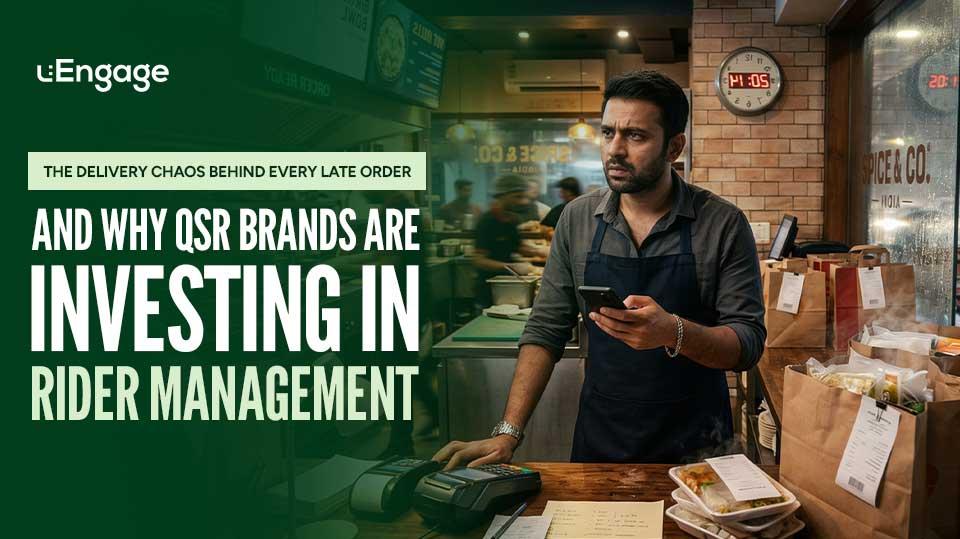
Most restaurant brands think delivery problems start when orders increase.
That’s not entirely true.
The real problem starts when operations fail to scale with those orders.
Because once restaurants begin handling:
-
multiple delivery zones,
-
peak-hour traffic,
-
rider coordination,
-
delayed dispatches,
-
and third-party logistics…
Delivery operations become messy very quickly.
And customers notice it immediately.
Late deliveries.
No tracking updates.
Cold food.
Confused riders.
Missed orders.
One bad delivery experience is often enough to lose a repeat customer.
That’s exactly why QSR brands in India are now investing heavily in rider management systems and smarter delivery operations.
Because in 2026, food quality alone is not enough.
Delivery experience has become part of the brand experience.
Why Restaurant Deliveries Start Breaking at Scale
In the early stages, many restaurants manage deliveries manually.
A few riders.
A few locations.
Simple dispatching.
But once order volume increases, cracks begin to appear.
Restaurants start struggling with:
-
rider allocation,
-
route confusion,
-
delayed dispatch,
-
communication gaps,
-
and delivery tracking visibility.
Especially during lunch and dinner rush hours, operations become difficult to manage without a proper delivery management system.
And honestly?
Most restaurant delivery issues are not caused by riders.
They are caused by operational chaos behind the scenes.
What Is Rider Management in Restaurant Delivery Operations?
Rider management refers to the process of managing:
-
delivery riders,
-
dispatch operations,
-
delivery tracking,
-
route optimization,
-
and order assignment efficiently.
A modern rider management system for restaurants helps brands:
-
assign deliveries faster,
-
track riders live,
-
optimize routes,
-
reduce delays,
-
and improve delivery performance overall.
Instead of manually coordinating deliveries over calls and chats, restaurants can manage everything from a centralised dashboard.
Why QSR Brands in India Are Prioritizing Rider Management
The QSR industry in India has changed rapidly over the last few years.
Customers now expect:
-
faster deliveries,
-
live tracking,
-
accurate ETAs,
-
and seamless ordering experiences.
According to industry trends, hyperlocal food delivery demand continues to rise across Indian cities, especially among mobile-first consumers.
At the same time, restaurants are facing increasing pressure to:
-
reduce delivery delays,
-
improve efficiency,
-
and maintain customer satisfaction during peak hours.
That’s why many QSR brands are moving toward:
rider tracking systems
delivery management software
dispatch automation
hyperlocal delivery platforms
Because manual coordination simply doesn’t scale anymore.
The Biggest Delivery Problems Restaurants Face Today
1. Delayed Rider Allocation
Many restaurants still assign riders manually.
During rush hours, this creates:
-
slower dispatch,
-
rider confusion,
-
and delayed deliveries.
A proper delivery dispatch system automates rider assignment based on:
-
availability,
-
location,
-
and delivery zones.
2. Lack of Real-Time Rider Tracking
Customers expect visibility.
If customers cannot track deliveries properly, frustration increases quickly.
That’s why modern rider tracking software has become essential for restaurant operations.
Live tracking improves:
-
transparency,
-
customer confidence,
-
and delivery coordination.
3. Poor Route Optimization
Without route optimization:
-
riders waste time,
-
fuel costs increase,
-
and delivery delays become common.
Smart delivery systems now use route optimization to help riders complete deliveries faster and more efficiently.
4. Communication Gaps Between Teams
Restaurants often struggle with coordination between:
-
kitchen staff,
-
dispatch teams,
-
and riders.
This leads to:
-
missed updates,
-
order confusion,
-
and slower delivery flow.
Integrated restaurant delivery management platforms reduce these operational gaps significantly.
How Rider Management Systems Improve Restaurant Operations
Modern rider management software for restaurants helps QSR brands streamline delivery operations through:
-
automated rider assignment
-
real-time tracking
-
delivery analytics
-
centralized dashboards
-
dispatch management
-
route optimization
-
delivery performance insights
Instead of reacting to delivery issues manually, restaurants gain operational visibility proactively.
And that changes everything at scale.
Hyperlocal Delivery Is Changing Restaurant Operations in India
One of the biggest shifts happening right now is the rise of hyperlocal delivery systems.
Customers no longer want to wait:
45–60 minutes for nearby deliveries.
They expect:
-
faster fulfillment,
-
accurate tracking,
-
and smoother experiences.
That’s why many restaurants are now building hybrid delivery ecosystems using:
-
in-house riders,
-
third-party delivery integrations,
-
and hyperlocal delivery management platforms together.
Because operational flexibility matters more than ever.
In-House Riders vs Third-Party Delivery Partners
Restaurants today often use a mix of:
-
internal rider fleets,
-
and external delivery partners.
Both have advantages.
| In-House Riders | Third-Party Delivery |
|---|---|
| Better operational control | Easier scalability |
| Direct customer experience | Faster expansion |
| Brand consistency | Lower hiring dependency |
| Better customer communication | Flexible availability |
The smartest QSR brands are not choosing one over the other.
They are building systems that manage both efficiently.
What Features Should Restaurants Look for in Rider Management Software?
Before choosing a restaurant rider management system, brands should look for:
-
real-time rider tracking
-
automated dispatching
-
delivery analytics
-
route optimization
-
order status updates
-
fleet management dashboard
-
delivery partner integrations
-
proof-of-delivery support
-
customer communication tools
Because delivery operations are no longer just backend logistics.
They directly impact customer retention.
Why Delivery Experience Matters More Than Ever
Here’s the reality:
Customers usually remember:
-
delayed orders,
-
missing tracking,
-
and poor delivery experiences
more than they remember a good meal.
As one restaurant operator put it:
“Customers don’t separate delivery from the brand anymore.
A late delivery feels like a bad restaurant experience.”
That’s why delivery infrastructure is becoming a strategic priority for QSR brands across India.
The Future of Restaurant Delivery Operations in India
Restaurant delivery in India is moving toward:
-
automation,
-
real-time visibility,
-
and operational intelligence.
QSR brands are increasingly investing in systems that combine:
-
rider management,
-
dispatch automation,
-
delivery tracking,
-
customer communication,
-
and hyperlocal logistics together.
Because scaling restaurant delivery operations manually is becoming impossible.
And in 2026, delivery efficiency is no longer just an operational metric.
It’s a growth metric.
Final Thoughts
Restaurant deliveries don’t break because riders fail.
They break because operations become difficult to manage at scale.
That’s exactly why QSR brands in India are investing in:
-
delivery tracking platforms,
-
and smarter operational workflows.
Because faster deliveries today are not just about speed.
They’re about:
-
customer trust,
-
repeat business,
-
and long-term brand experience.
And as food delivery expectations continue to rise in India, operational efficiency will become one of the biggest competitive advantages for restaurant brands.