For years, restaurant marketing automation was treated as a campaign machine.
Send offers.
Push discounts.
Trigger messages.
Repeat.
And for a while, it worked.
But in 2026, most restaurant brands are discovering a hard truth: running more campaigns is not the same as building growth.
Despite using CRMs, loyalty tools, WhatsApp broadcasts, emailers, and automation platforms, repeat orders are flattening. Marketing teams are busy, dashboards look active, yet retention feels fragile.
This has shifted the conversation from “How many campaigns did we run?” to a more uncomfortable question:
Why aren’t customers coming back even after all this automation?
The answer lies in misunderstanding what restaurant marketing automation is actually meant to do.
The Original Promise of Restaurant Marketing Automation
At its core, restaurant marketing automation was designed to help brands:
-
Reduce manual marketing work
-
Communicate at scale
-
Segment customers
-
Trigger messages based on actions
For restaurants, this brought speed and structure. Campaigns could be launched faster, audiences could be segmented, and outreach became more consistent.
But automation alone doesn’t guarantee impact.
According to industry research, over 65% of automated restaurant campaigns fail to improve long-term repeat behaviour. They generate short spikes, not sustained growth.
Why?
Because most automation is still campaign-centric, not retention-centric.
Campaigns Create Activity. Retention Creates Growth.
Campaigns answer questions like:
-
What message should we send today?
-
What offer will convert fastest?
-
How do we push volume this week?
Retention answers very different questions:
-
Why did this customer come back?
-
What experience made them stay?
-
What behaviour signals predict repeat orders?
Most restaurants confuse the two.
They automate campaigns, but don’t automate relationships.
This is where modern restaurant marketing automation software needs to evolve.
Why Campaign-Led Automation Starts Breaking at Scale
As restaurants grow, complexity increases:
-
More locations
-
More ordering channels
-
More customer segments
-
More delivery variables
Campaign-first automation struggles in this environment because it treats all customers as messaging targets, not evolving relationships.
Studies show:
-
73% of customers expect brands to remember their preferences
-
Loyal customers spend 67% more over time
-
Retention improves profits by 25–95%
Yet most automated restaurant campaigns still rely on:
-
Static segments
-
Generic offers
-
One-size-fits-all journeys
This disconnect explains why many brands invest heavily in restaurant marketing automation but see diminishing returns.
Retention Is a System, Not a Campaign
Retention isn’t built through one message.
It’s built through consistent experiences over time.
That means automation must extend beyond marketing into:
-
Ordering behaviour
-
Loyalty mechanics
-
Feedback loops
-
Customer lifecycle tracking
Modern customer retention automation connects these layers so automation reacts to what customers do, not just what marketers plan.
Behaviour Is the New Trigger
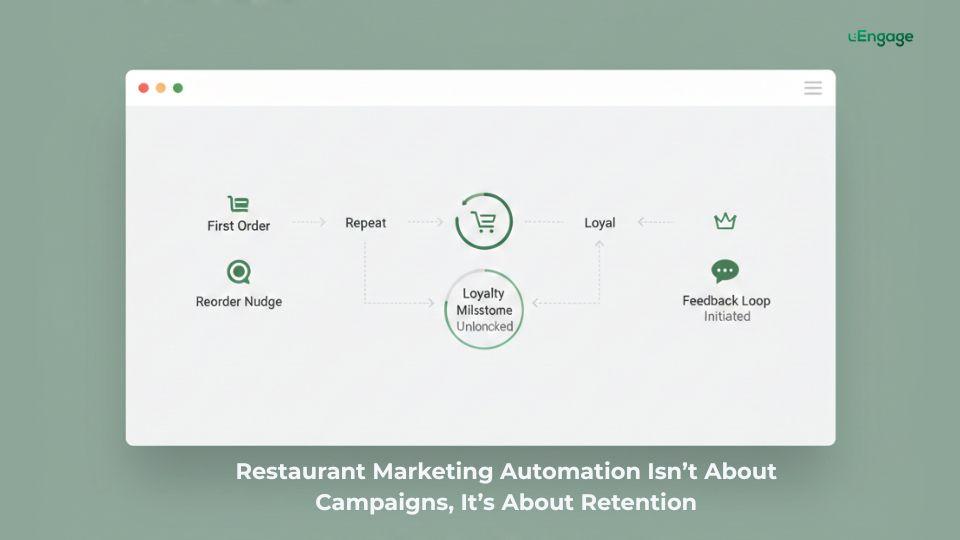
The most effective restaurant marketing automation systems in 2026 are behaviour-led.
Instead of asking, “What campaign should we send?” they ask:
-
Did this customer’s order frequency drop?
-
Is their average basket shrinking?
-
Did delivery experience impact reorders?
-
Is this guest at risk of churn?
Behaviour-based automation can trigger:
-
Re-order nudges
-
Win-back journeys
-
Loyalty milestone rewards
-
Personalised offers
-
Experience recovery flows
Research shows that behaviour-driven automation improves repeat orders by up to 40% compared to time-based campaigns.
Where Most Restaurant Marketing Automation Tools Fall Short
Many tools promise automation, but deliver only scheduling.
Common gaps include:
-
Automation not connected to ordering data
-
Loyalty running separately from campaigns
-
Feedback data not influencing journeys
-
CRM insights not tied to real outcomes
As a result, marketing teams operate in silos, reacting to metrics instead of shaping behaviour.
This is where restaurants begin re-evaluating their automation stack.
How uEngage Prism Reframes Restaurant Marketing Automation
uEngage Prism approaches restaurant marketing automation from a retention-first perspective.
Instead of treating automation as a campaign engine, Prism functions as a connected retention system that links:
-
Customer behaviour
-
Ordering patterns
-
Loyalty logic
-
CRM insights
-
Automated journeys
This allows brands to move from pushing messages to guiding customer lifecycles.
With Prism, automation is triggered by:
-
Order frequency changes
-
Visit gaps
-
Loyalty milestones
-
Feedback signals
-
Channel preferences
This turns restaurant marketing automation into a growth engine rather than a broadcast tool.
Automation That Works Even When Teams Aren’t Watching
One of the biggest advantages of retention-focused automation is consistency.
Restaurants using connected automation systems report:
-
60–70% reduction in manual marketing effort
-
More predictable repeat behaviour
-
Lower dependency on discounts
Because journeys run continuously, not just during campaigns.
As one multi-location operator shared:
“Our marketing didn’t improve because we sent more messages. It improved because the system knew when not to send them.”
Loyalty, CRM & Automation Must Work Together
True retention automation doesn’t live in isolation.
It requires:
-
Restaurant CRM automation to understand customer history
-
Loyalty systems that reward behaviour, not just spending
-
Automated restaurant campaigns that adapt in real time
This convergence is what separates basic automation tools from retention platforms.
Prism is built around this convergence, where loyalty, CRM, and automation reinforce each other instead of operating separately.
Why Discounts Stop Working Without Retention Logic
Discount-heavy automation creates transactional customers.
Studies show that over-discounting reduces long-term retention by training customers to wait for offers.
Retention-led restaurant marketing automation focuses instead on:
-
Recognition
-
Relevance
-
Timing
-
Experience continuity
This builds emotional loyalty, not just price sensitivity.
What Restaurants Should Look for in Marketing Automation in 2026
Before choosing or upgrading automation tools, brands should ask:
-
Does automation respond to customer behaviour?
-
Is ordering data part of the automation logic?
-
Can loyalty, CRM, and campaigns work together?
-
Does this reduce manual effort or add complexity?
-
Does it improve repeat orders, not just clicks?
If the answer is no, it’s automation without retention.
The Bigger Shift: From Campaigns to Customer Lifecycles
The restaurant industry is slowly moving away from campaign thinking toward lifecycle thinking.
As one restaurant tech analyst noted:
“Automation only creates growth when it understands the customer journey, not just the marketing calendar.”
This shift explains why restaurant marketing automation in 2026 looks very different from what it did just a few years ago.
Final Thoughts
Restaurant marketing automation was never meant to be about campaigns.
It was meant to make growth sustainable.
In 2026, the brands that win are not the ones sending more messages, they’re the ones using automation to understand, retain, and grow their customers intelligently.
Platforms like uEngage Prism reflect this evolution:
from campaign execution → to retention infrastructure.
Because in the end, automation doesn’t create loyalty.
Experiences do.
And automation should exist to support them.