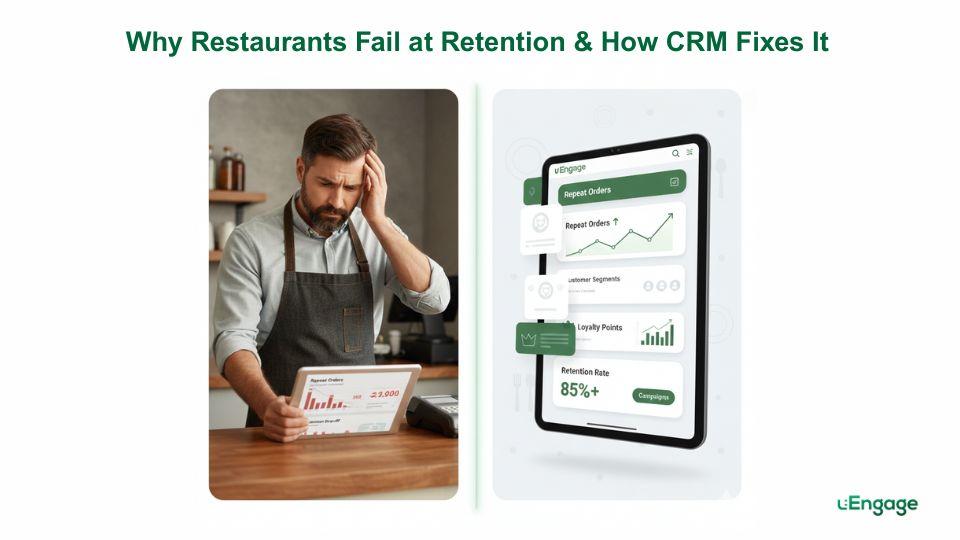
Most restaurants believe they have a marketing problem.
In reality, they have a retention problem.
Every month, restaurants spend heavily on ads, discounts, and aggregator visibility to bring in new customers. Orders come in, revenue looks decent, but something quietly breaks in the background.
Those customers don’t come back.
“Restaurants don’t lose money because customers don’t order once.
They lose money because customers don’t order again.”
And in 2026, this gap between acquisition and retention has become the biggest growth blocker for F&B brands.
The Real Reason Restaurants Fail at Retention
Let’s be honest, most restaurants don’t actively choose to ignore retention.
They fail at it because:
-
Retention feels complex
-
Customer data is scattered
-
Tools are disconnected
-
Decisions are made on gut, not data
Without a structured system, retention becomes accidental instead of intentional.
This is exactly where restaurant CRM software steps in.
The Cost of Poor Retention (The Numbers Don’t Lie)
Industry stats every restaurant should know:
-
Acquiring a new customer costs 5–7× more than retaining an existing one
-
A 5% increase in retention can boost profits by 25–95%
-
Loyal customers spend 67% more over their lifetime
-
Over 70% of restaurant revenue comes from repeat customers
Yet most restaurants still spend 80% of their marketing budget on acquisition.
That’s not growth. That’s leakage.
Where Restaurants Go Wrong (Common Retention Mistakes)
1. No Customer Visibility
Restaurants often don’t know:
-
Who their repeat customers are
-
Who has stopped ordering
-
Who spends the most
-
Who needs re-engagement
Without visibility, retention becomes impossible.
2. Generic Marketing for Everyone
Same offer. Same message. Same timing.
But customers are not the same.
High-value customers expect exclusivity.
Infrequent customers need nudges.
At-risk customers need win-back strategies.
This is where customer retention tools outperform manual marketing.
3. Loyalty Without Intelligence
Many loyalty programs fail because they are:
-
Static
-
Coupon-driven
-
Not behavior-based
Without CRM insights, loyalty becomes a discount engine, not a growth engine.
What Restaurant CRM Software Actually Fixes
Restaurant CRM software is not just a database.
It is the control center for retention, loyalty, and long-term growth.
Here’s how it fixes what’s broken
1. Centralised Customer Data (The Foundation)
CRM software brings together:
-
Order history
-
Frequency
-
Spend patterns
-
Preferences
-
Feedback
-
Engagement data
Suddenly, restaurants can see:
-
Who orders weekly
-
Who hasn’t ordered in 30 days
-
Who has high lifetime value
This visibility alone improves decision-making.
“You can’t retain customers you don’t understand.”
2. Smart Segmentation = Better Retention
With modern restaurant CRM software, brands can create segments like:
-
VIP customers
-
Infrequent users
-
New customers
-
At-risk customers
-
High spenders
This allows personalised retention strategies, not blanket campaigns.
Segmented campaigns convert 4–6× better than generic ones.
3. CRM-Powered Loyalty That Actually Works
Loyalty succeeds only when it’s:
-
Personalized
-
Behavior-based
-
Easy to redeem
CRM-driven loyalty programs enable:
-
Points on specific actions
-
Tier-based rewards
-
Special day bonuses
-
Personalized offers
This transforms loyalty from a cost center into a profit driver.
4. Customer Retention Automation (No Manual Chasing)
Manual follow-ups don’t scale.
CRM-powered customer retention automation helps restaurants:
-
Trigger win-back campaigns automatically
-
Send reorder nudges at the right time
-
Recover abandoned carts
-
Push loyalty reminders
-
Automate birthday & anniversary offers
Result:
- Lower churn
- Higher repeat orders
- Less manual effort
5. Turning Feedback Into Retention Signals
Most feedback is collected too late, or ignored.
CRM software helps restaurants:
-
Capture post-order feedback
-
Identify unhappy customers instantly
-
Trigger recovery actions before churn
Restaurants using structured feedback systems see 20–25% higher customer recovery rates.
Real-World Example
A growing multi-outlet restaurant brand was facing:
-
High ad spends
-
Low repeat rates
-
No clarity on customer behaviour
After implementing a CRM-driven retention setup:
-
Repeat orders increased by 35% in 90 days
-
Discount dependency reduced
-
Marketing ROI improved significantly
The biggest shift?
They stopped guessing, and started acting on data.
Why 2026 Is the Turning Point for CRM-Led Retention
Three major changes are happening together:
-
Customers expect personalised engagement
-
Restaurants need predictable revenue
-
Data-driven tools are now accessible
This is why searches for restaurant CRM software and customer retention tools are accelerating in 2026.
“Retention is no longer a nice-to-have.
It’s the core growth strategy.”
What to Look for in Restaurant CRM Software
Before choosing a CRM, restaurants should ensure it supports:
-
Customer segmentation
-
Loyalty integration
-
Automation workflows
-
Feedback management
-
Analytics & insights
-
Multi-location scalability
Generic CRMs rarely understand restaurant behavior.
Purpose-built platforms perform better.
How uEngage Prism Solves Retention at Scale
uEngage Prism is built specifically for F&B brands.
It combines:
-
Restaurant CRM software
-
Loyalty engine
-
Customer retention automation
-
Feedback management
All inside a single ecosystem.
Restaurants using Prism are able to:
-
Increase repeat orders
-
Reduce churn
-
Improve customer lifetime value
-
Build predictable, long-term growth
Final Thoughts
Restaurants don’t fail because customers don’t like their food.
They fail because they don’t build relationships.
In 2026, the winning brands are not the ones spending more on ads, but the ones investing in retention systems.
“Acquisition gets customers in.
Retention keeps the business alive.”
And restaurant CRM software is the backbone of that retention-first future.